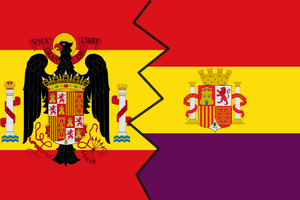

On January 1, 1936, Spain starts out still as the Second Republic, a democracy on the edge of collapse. The civil war isn't long in coming, and this guide focuses on the Nationalist side, the one that historically won it under Francisco Franco. But winning the war isn't the end of the story — the  Recovering From Civil War spirit is waiting for you on the other side, and your own side isn't even unified: Falangists and Carlists are competing for power, and pushing either one too hard can light up a second civil war inside the first.
Historical background
The Second Republic, proclaimed in 1931 after King Alfonso XIII's abdication, faced heavy instability — a failed coup in 1932 and the Asturian miners' revolution in 1934 — until, with the game already underway, a group of generals led by Francisco Franco rose against the Popular Front government in July 1936, triggering the civil war that the Nationalist side historically won with backing from  Italy and
  Germany, against a
  USSR backing the Republicans.
What changes with La Résistance
The La Résistance DLC (2020) is what gives Spain its own focus tree — both the starting Republic and the Nationalist side once the country splits — with the branches covered in this guide. Without it, the nation runs on the generic tree shared by every country without a dedicated one, which is far more limited. This guide assumes La Résistance is active and focuses on the Nationalist side once the civil war breaks out.
National spirits of the Nationalist side
Once you're in control of the Nationalist side, you start with three spirits of your own, and all three are directly tied to the civil war already underway: one describes the toll of rebuilding the country, and the other two describe the tensions within your own side.
Recovering From Civil War
+20% consumer goods factories, −10% construction speed, −20% factory output, −20% dockyard output, +50% join-faction tension limit — the price of rebuilding a country split in two.

Expand Conscription
+2% recruitable population factor — the civil war demands a renewed recruitment push with no letup.

Carlism
+1% recruitable population factor, +5% infantry division attack, +5% infantry division defense — the legacy of nearly a century of Carlist wars over the line of succession to the throne.
The bill for winning the war
The Recovering From Civil War spirit is the one that really shapes the game, and a lot of new players don't see it coming: winning the civil war doesn't free you up, it leaves you with −20% factory output and dockyard output, and −10% construction speed, right when you need to rebuild the most. It's the direct mechanical echo of the real "years of hunger" that followed the war: Spain won the internal conflict and still took years to get back on its feet. A large chunk of the focus tree exists specifically to strip this penalty away as fast as possible.
The focus tree's branches
Spain's (Nationalist) tree is organized into eleven sections: an opening branch before the civil war ends, three main branches splitting power within the Nationalist side, two branches shared between factions, and several sub-branches that only unlock once the civil war is over.
 A Great Spain — the opening branch: popularity for the fascist and non-aligned parties, political power, garrison control over various Spanish states, and extra divisions while the civil war lasts.
 The Phalanx Ascendant — brings the Falangists to power: stability, minor uprisings against the Republicans, a research slot, and more factories. Forces the Carlists to declare war.
 Unify the Nationalist Front — aligns Falangists and Carlists under Franco's leadership: stability, war support, combat bonuses, and it bypasses the looming Carlist revolt.
 Supremacy of the Communion — the Carlist path: preparing insurrections, army bonuses, air and land research, and civilian factories. Forces the Falangists to declare war.
 Corpo Truppe Volontarie / The Condor Legion — shared between Falangists and Nationalists: more Italian and German volunteers, forts on the French border, stability, political power, and research bonuses.
 Utilize the Intellectuals — shared between Nationalists and Carlists: an extra research slot.
Once the civil war ends, each path opens its own postwar sub-branches: the Falangist National-Syndicalist State rebuilds the Spanish Empire with war goals against  Portugal, the
  United Kingdom,
  France and Italy; Join
  the Allies / Adopt the 26 Points pulls Spain toward Britain or
  the United States and removes the Recovering From Civil War penalty; and Restore the Monarchy — available to both Nationalists and Carlists — decides who ends up on the throne. These monarchist-restoration routes and the further ideological alignment paths that follow are numerous and overlap heavily, so this guide doesn't dig into their exact detail.
Franco unified or the internal split
The single most important decision in the whole game isn't against the Republicans — it's inside your own side. Unify the Nationalist Front is the historical route: Franco keeps Falangists and Carlists under one command without letting either dominate, exactly what happened in reality. It's the safe choice, and the one recommended for a first playthrough as Spain.
The alternative is picking a side: The Phalanx Ascendant or the Carlist Supremacy of the Communion. Both routes offer real advantages — more factories, more research, uprisings against the Republicans — but both force the other faction to declare war on you. You end up with a literal second civil-war front, this time inside your own Nationalist side, while the war against the Republicans may still be unresolved. Only worth it once you've got a handle on the game and want an extra challenge.
The Civil War: fast or long
Before touching the focus tree, decide what kind of game you actually want. You can wrap up the civil war in a few months and get straight to rebuilding, or drag it out on purpose to bank combat experience with your troops. If this is your first game as Spain, go fast: the sooner the war ends, the sooner the clock starts running on shedding Recovering From Civil War, and an unstable country bleeds factory efficiency into everything that follows.
Spain in the real war
If you want to follow the historical script of calculated neutrality after the civil war, here's the real sequence:
- Hendaye meeting (October 1940) — Franco negotiates with Hitler over joining the Axis in exchange for Gibraltar and North Africa; talks collapse.
- Blue Division (1941) — Spanish volunteers fight alongside Germany on the Eastern Front without Spain formally entering the war.
- Quiet naval support — German U-boats refuel in Spanish ports throughout the war.
- Tungsten to Germany — the Spanish mineral, crucial for weapons manufacturing, is exported to German industry for much of the conflict.
- Postwar isolation (from 1945) — Spain is shut out of the UN and suffers the "years of hunger" under autarky, until the economic turnaround of the 1950s.
Where value gets lost
The most common mistake is letting the civil war run longer than it needs to: every extra month is a month the industrial branch isn't moving, and by the time the world war breaks out Spain is left behind the rest of the mid-tier powers. The second is jumping into the internal split (Phalanx or Communion) without accounting for fighting on two internal fronts at once. The third is ignoring Recovering From Civil War and launching into any ambitious postwar plan before shedding it.
Spain's achievements

Nobody Expects...
As Nationalist Spain in the Axis, take Paris before the Germans do.

One King, Two Crowns
As Kingdom of Spain, own all Spanish and French cores.

Our Chief Weapon is Surprise...
As Spain, have 5 spies and stage 5 coups.

We Will Rock You
As Spain, own Gibraltar.