
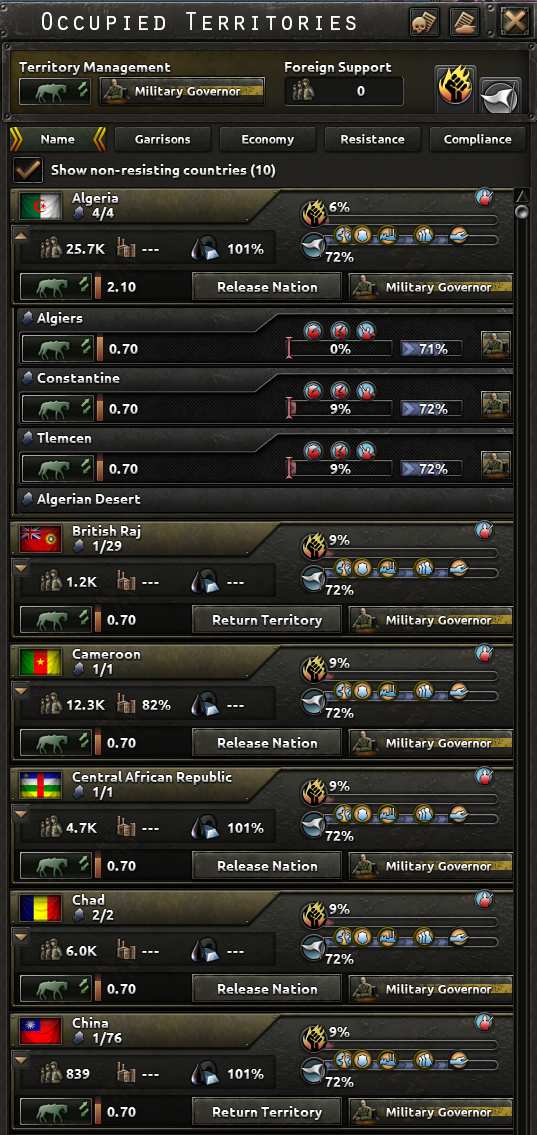
Every state that isn't a core of your country drags along two independent numbers almost nobody watches until it's too late: resistance, which measures how rebellious the population is, and compliance, which measures how much of that population already sees you as a legitimate authority. Ignoring them isn't free — past certain resistance thresholds the game doesn't just penalize you, it takes the territory away outright.
What Resistance and Compliance Are
The moment you capture a state, resistance starts at 1% and from there slowly rises or falls toward its resistance target — a value calculated from a 35% base, adjusted up or down depending on whether the target country has capitulated, has a government in exile, how many victory points sit in the state, your stability, your occupation laws, and even the resistance of neighboring states (part of it spreads). Compliance, by contrast, starts at 0% in freshly conquered territory (non-core states that already existed at game start begin directly at 70%) and rises steadily and independently of resistance, though at a frustratingly slow pace by default.
Resistance: the 4 Thresholds You Can't Ignore
Resistance isn't just a decorative number: once it crosses certain thresholds, increasingly severe penalties kick in, and the last one isn't a simple penalty at all.
 Organized Resistance (25%) — +50% chance for resistance to penetrate your garrison.
 Emboldened Resistance (50%) — +100% damage to your garrisons.
 Uprising (75%) — -50% division speed, strategic redeployment disabled, -50% local supplies, and +30% attrition, all of it only for you as the occupier.
 Rebellion (90%) — -3% local factories, and the state genuinely breaks away: control switches to the rebel nation (restored if it no longer exists), which receives between 2 and 6 divisions depending on the state's factory count. If the state is a core of a country you occupy, that entire country can declare independence.
Compliance: Why It Rises So Slowly and What It Gives You
Base compliance rises only 0.075% a day — with no help from occupation laws, leader traits, or national spirits, going from 0% to 100% would take more than three years of campaign time. It's also offset by decay proportional to the compliance already banked (up to -0.083% a day at 100%), so the higher it climbs, the harder it gets to keep pushing it further. In exchange, compliance literally determines how much that territory produces: available factories follow the formula 100% − 75% + 65% × compliance, resources follow 100% − 65% + 65% × compliance, and manpower follows 100% − 98% + 18% × compliance — a state at 100% compliance gives you 90% of its factories but only 20% of its potential manpower.
Past certain average compliance thresholds across all your occupied territories, additional bonuses unlock:
 Informants (15%) — +25% enemy agent detection.
 Local Police Force (25%) — -25% required garrisons and +0.5% additional recruitable population.
 Reorganized Workforce (40%) — +10% local resources and +10% local factories.
 Volunteer Program (60%) — +20% recruitable population.
 A New Regime (80%) — triggers the event to set up a collaboration government, which turns the territory into a puppet and eliminates resistance entirely.
Garrisons: How Much Force You Really Need
Every point of resistance demands 0.75 points of suppression from your garrison in that state. Two details almost nobody accounts for: even if resistance sits below 10%, the game calculates required garrison as if it were at 10% anyway — there's no "state so calm it needs nothing" — and at the other end, above 50% resistance the garrison requirement stops scaling, as if it were capped at 50%. If you don't fully cover the garrison reinforcement order, every effect of your occupation law gets reduced proportionally to whatever manpower or equipment is missing, so a poorly-supplied garrison doesn't just stop suppressing resistance — it also cancels out part of what that law should be giving you.
Common Mistakes
- Treating a low-resistance state as "under control" — it still demands minimum garrison as if it were at 10%, leaving it empty doesn't work.
- Not reacting until resistance is already at Rebellion (90%) — by then it's too late to avoid losing the territory, enemy divisions included.
- Expecting compliance to rise on its own — at 0.075% a day with no help, you need an occupation law, a political advisor, or a resistance-suppression focus for it to climb at a reasonable pace.
- Ignoring an under-supplied garrison — if the reinforcement order isn't covered, your occupation law delivers far less than it promises on paper.