
The command tree is easy to leave on autopilot, but a general with the right traits can decide an even battle. The detail most people miss: a general's traits and skill level only apply to their armies at 50% effectiveness the moment you delegate them under a field marshal, so climbing the command ladder isn't always free.
Generals and Field Marshals
A general commands an army — a group of divisions assigned directly to them. A field marshal sits a level above: they oversee several armies within an army group. Hiring a new general or admiral costs 5 political power for each one you already have, up to a maximum of 80 per hire, and has a 95% chance of starting at skill level 1 (and a 5% chance of starting straight at level 2).
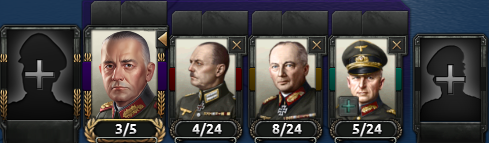
The «X/Y» number under each portrait is the key to reading this hierarchy at a glance: on a field marshal it shows how many armies they're leading out of their maximum (3 of 5 in the example), and on a general, how many divisions they have assigned out of their command limit (4 of 24, 8 of 24, 5 of 24). The slots with a «+» are open commands, ready to assign a new general or army without having to reshuffle the whole group.
 Command Capacity: The Exact Numbers
A general can lead up to 24 divisions without penalty — or up to 72 while in "Garrison Area" mode. Above that limit, both their bonuses and experience gain shrink proportionally, not just the bonuses. A field marshal, in turn, can lead up to 5 armies (7 with the "Expert Delegator" trait), and an admiral up to 10 task forces. Splitting the army well across several commands, instead of stacking everything under one general, avoids this silent overload penalty.
The 50% Penalty From Delegating
Here's what almost nobody accounts for: once a general falls under a field marshal within an army group, their own traits and skill level apply to the subordinate armies at only 50% effectiveness. The exception is "Personality" traits (like Cautious or Old Guard), which pass down to generals with no penalty at all. The field marshal's own traits, on the other hand, apply at full strength to every army in their group — which is why a strong field marshal with solid general-purpose traits often pays off more than relying purely on individual generals with heavy specialization.
Battle Plans: Directing the Front
A battle plan isn't mandatory to give orders, but it's what lets the AI move your divisions automatically and coherently instead of you micromanaging each one by hand. The battle plan toolbar opens when you select an army (a general) or an army group (a field marshal):

 Exercise — sets the selected divisions to train for experience; it cancels any active battle plan (though not movement orders) and leaves them with very low organization, so it's best to keep them away from the front while it lasts.
 Execution Mode — sets whether the AI carries out the plan carefully, in a balanced manner, or aggressively.
 Cohesion — controls how rigidly or flexibly the AI redistributes divisions along the front dynamically.
 Naval Invasion — left-click the departure port and right-click the enemy coast to invade; by default only 4 divisions fit per order and only one order can be active at a time (naval research raises both caps), and the bigger the invasion, the more prep days it demands.
 Naval Invasion with Floating Harbor — same mechanic as above, but supplies the troops during the landing at the cost of spending a floating harbor from the stockpile. Requires No Step Back.
 Paradrop — requires a division made up entirely of paradrop-capable battalions (the paratrooper battalion is the only line battalion that qualifies) and a minimum of 50 transport planes at the departure air base; executing the order needs about 45 planes per division assigned and at least 70% air superiority (or neutral air) along the whole route.
 Front Line — the mandatory starting point: marks where the selected divisions gather before advancing.
 Offensive Line — the target they advance toward from the front line, covering its own flanks and adapting to the terrain as it goes.
 Spearhead — instead of spreading out and adapting, it advances along a single one-province-wide path toward the exact target you draw; built for Blitzkrieg-style armored penetrations aimed at sealing an encirclement, not covering a wide front. Only usable at army level, not army group level.
 Fallback Line — tells the AI to retreat to that line, hold it, and counter-attack if it's broken. Unlike a front line it gives no planning bonus, but divisions that stay in the same province a long time still accumulate entrenchment.
 Area Defense — spreads the army across an entire territory instead of concentrating it on a line; it's the mode behind the "Garrison Area" mentioned above, with options to protect specific ports, coasts, airbases, forts, or supply hubs.
 Divisions Assignment Mode — left-click (holding Ctrl) on a plan to assign the selected divisions to it, or right-click to select every division already assigned to that plan at once.
 Unassign Divisions — removes the selected divisions from whatever order they had, leaving them without a plan.
 Edit Mode — lets you tweak an already-drawn plan: lengthen or reshape front, offensive, or fallback lines, and move an offensive arrow's origin without having to delete it and redraw it.
 Delete Order — removes battle plans one at a time; right-click to delete every order of the selected army at once.
What Each Specialized Skill Does
Generals and field marshals level up four specialized skills through experience:  Attack (+2.5% soft and hard attack per level),
  Defense (+2.5% defense and breakthrough per level),
  Logistics (+2.5% less supply consumption per level), and
  Planning (+5% planning speed and +2% max planning per level). Matching each command's specialization to their role — a defensive field marshal on a front that's meant to hold, a planning specialist leading your main offensive — pays off more than letting them level up generically.
Active Abilities: What to Spend Command Power On
Besides the specialized skills that level up on their own with experience, every general and field marshal has access to active abilities that are paid for with command power the moment you use them — and the cost isn't flat, it's calculated per battalion under their command, so activating one on a 24-division army costs far more than on a small one. Three are available from the start to any general:
 Force Attack (+20% attack, +25% breakthrough, −100% organization damage taken, but +60% strength damage taken): lasts 7 days, no cooldown, and costs 0.22 command power per battalion. Meant to force a decisive breakthrough at the cost of higher-than-normal casualties.
 Last Stand (+20% defense, +25% entrenchment, −100% organization damage taken, but +60% strength damage taken): same 7-day duration and same 0.22-per-battalion cost as Force Attack, but for defense — for holding a stretch of the front that can't be allowed to give way under any circumstance.
 Staff Office Plan (+400% planning speed for 7 days): the cheapest of the three at 0.12 command power per battalion, with no cooldown — for front-loading a battle plan's preparation instead of waiting for the normal ramp-up.
The practical takeaway: since the cost scales with army size, there's no point leaving these on by default — save them for the exact moment you're launching the decisive offensive or need to hold at all costs, not as a button you mash without thinking. Beyond these three, certain general traits unlock more specific active abilities (for example, Extra Supplies with the Logistics Wizard trait, or Siege Artillery with Fortress Buster) — but those depend on what each general has specialized into through experience.
More Command Traits: Logistics, Planning, and Doctrine
Beyond the specialized skills and active abilities above, generals and field marshals also develop command traits through experience — they're not locked to one rank, either can end up specializing in them. Almost all of these branches share a common prerequisite trait,  Organizer (+10% planning speed, 1,000 XP, earned by using battle plans at army level — it doesn't progress with field-marshal-level plans). These are just an example of the many that exist:
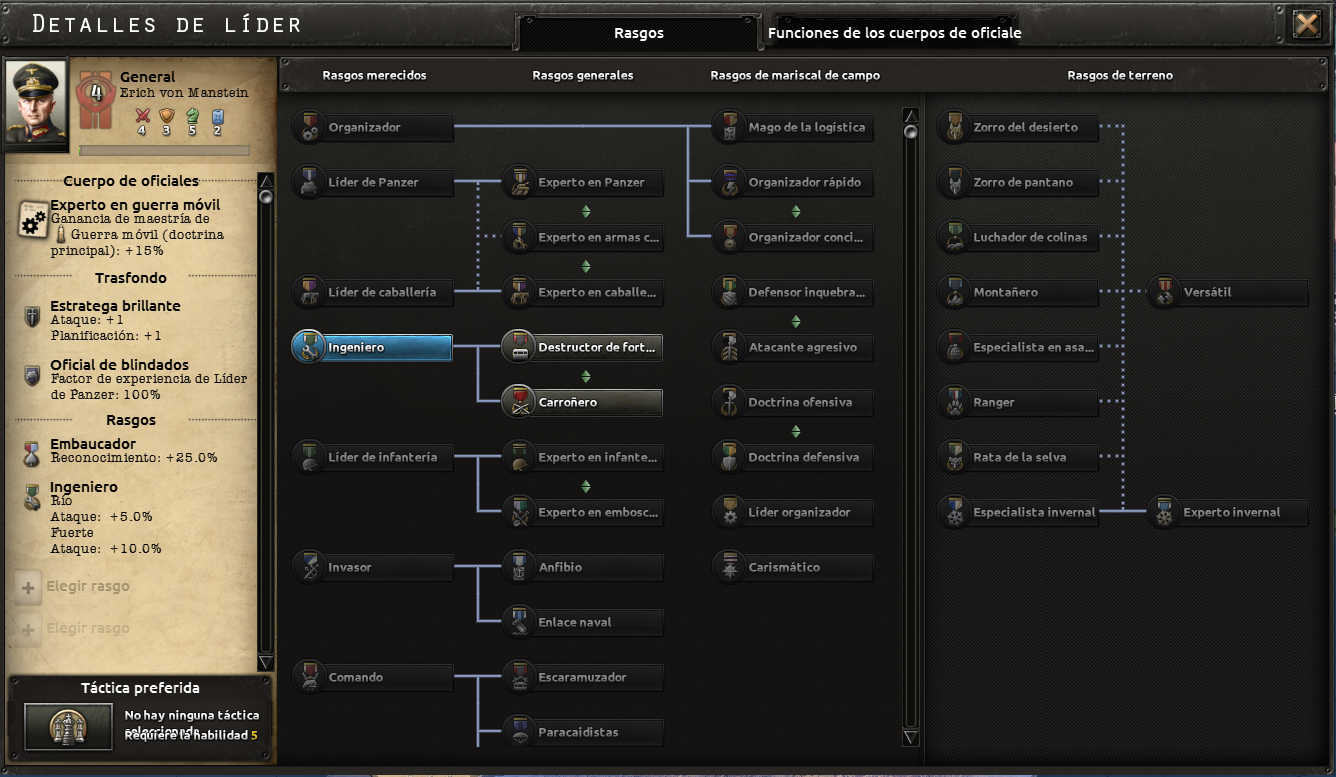
 Logistics Wizard — -15% supply consumption and unlocks the Extra Supplies active ability mentioned above.
 Fast Planner — +25% planning speed, exclusive with Thorough Planner.
 Thorough Planner — +10% to max planning, exclusive with Fast Planner.
 Unyielding Defender — +10% defense and a higher chance of executing the Counter-Attack tactic, exclusive with Aggressive Assaulter.
 Aggressive Assaulter — +10% breakthrough and a higher chance of executing the Assault and Shock tactics, exclusive with Unyielding Defender.
 Offensive Doctrine — -30% organization loss when moving and +1 attack skill, exclusive with Defensive Doctrine.
 Defensive Doctrine — +30% max entrenchment, exclusive with Offensive Doctrine.
 Organization First — +2% reinforce rate.
 Charismatic — +10% division recovery rate.
 Expert Delegator — +2 to max armies per group, the trait we already mentioned above that raises the cap from 5 to 7.
Where Value Gets Lost
Ignoring command capacity and piling more than 24 divisions under a single general (outside garrison mode) is the most common slip — you lose both efficiency and experience gain without even noticing. The second is not accounting for the 50% penalty when organizing army groups: if your best generals have heavily specialized traits, it can pay off more to keep them as standalone generals than to fold them under a field marshal who dilutes half of what they bring.