
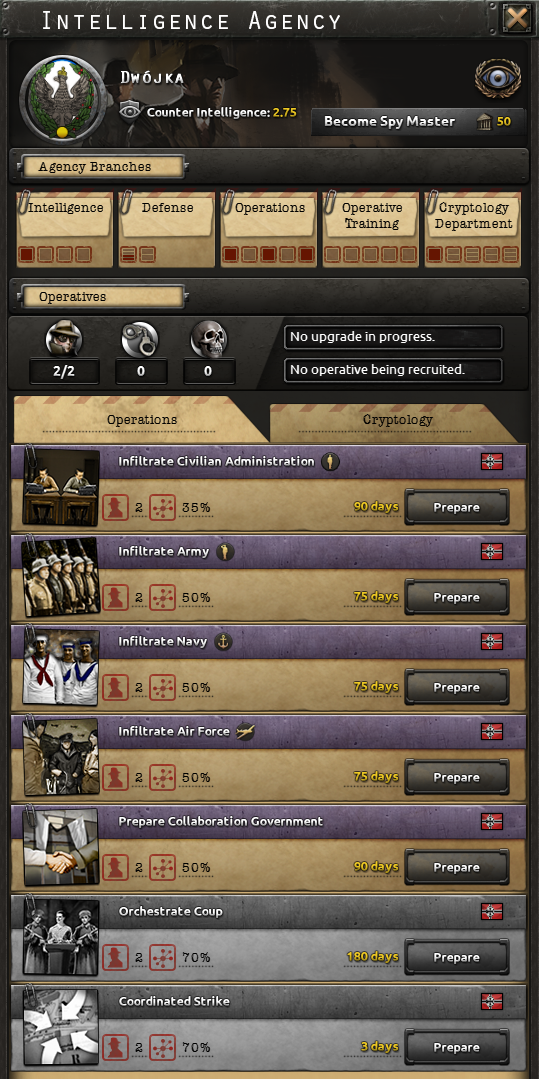
This one comes from the La Résistance DLC — without it, the intelligence agency doesn't exist for you. Setting one up has a real cost: 5 civilian factories invested for 30 days before it's operational, and every upgrade after that costs the same in time. With it active, spying (or being spied on) turns into a game within the game.
In our view, this is one of the most underrated mechanics in the game: most players either set it up without a plan or ignore it outright, when played well it offers advantages no other branch of the game does — from weakening enemy troops before you even invade to reading their radio traffic. That said, it isn't for every game: if you're playing a nation with little industry, it's not worth centering your civilian factories on building one — that same investment pays off far more in production or construction when you don't have industrial capacity to spare.
Espionage Operations
You recruit agents, train them, and infiltrate them into whichever country you're targeting. Once they're in, you can launch specific operations: steal tech blueprints, sabotage industrial production, damage their army or navy, or lay the groundwork for a coup. Every operation eats time and resources from your agency, so you have to prioritize instead of trying everything at once.
Before any operation you need to build an intel network in the target country, and that network does more than unlock operations: while it's active, it counters the dig-in bonus and the planning bonus of enemy divisions fighting inside its coverage, and boosts your local intel advantage in combat by 25%. It's not just information — it literally weakens enemy troops standing in that area before you fire the first shot.
 Agents: Hiring, Skill, and Traits
Your agency starts with a single active-agent slot, and the only way to get more is by buying agency upgrades (one every five) or through certain advisors and national focuses — the hard cap is 10 active agents at once. If you lose one (captured or killed on an operation), that slot stays empty for a mandatory 30 days before you can hire a replacement, so throwing agents into high-risk operations you didn't need to run has a cost that goes beyond the failed mission itself.
Every new agent starts at skill level 1 and levels up by earning experience through missions and operations; hitting level 2 already grants real bonuses to intel network growth, counter-intelligence, and operation success chance. On top of that, a freshly hired agent has a 50% chance of coming with at least one innate trait — like Safe Cracker, which boosts blueprint theft, or Seducer, which lowers infiltration risk — and a further 10% chance of a second one. Over time they can also earn extra traits, like Commando or Demolition Expert, both specialized in sabotage.
Which Upgrades to Prioritize First
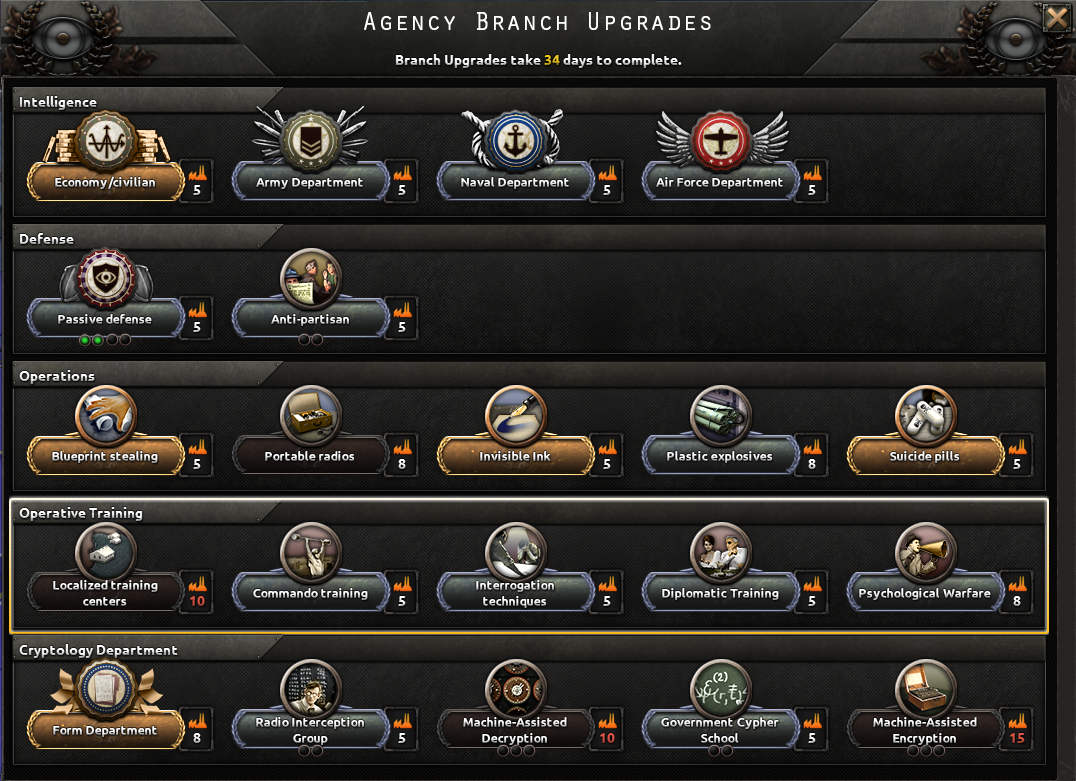
Agency upgrades split across 5 branches (Intelligence, Defense, Operations, Operative Training, and Cryptology), and each one costs between 5 and 15 civilian factories over 30 days (25 days with the "Illusive Gentleman" advisor). You don't need to chase all of them — two branches stand out well above the rest in value.
- Passive Defense — the first upgrade gives +1.5 counter-intelligence, and the following ones add +1.25 and +1 each. It slows down hostile operations on your territory and improves your odds of detecting enemy agents. It's the foundation of any defensive intelligence strategy.
- Form Department (Cryptology branch) — +25 decryption power and +1 cryptology level, and unlocks the rest of the branch. It's the mandatory first step if your goal is reading enemy communications.
Beyond those two, pick based on your style: Blueprint Stealing (+25% effectiveness stealing tech) if you're trying to catch up technologically fast, or Interrogation Techniques (+100% chance of capturing enemy agents) if you're expecting an active spy war against a specific rival.
 Code-Breaking
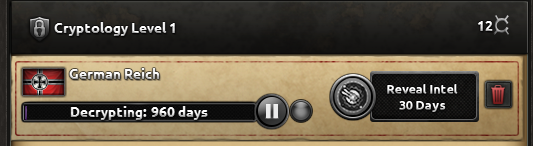
With enough decryption power built up through the Cryptology branch, you can start decrypting another country's radio traffic, gaining partial visibility into their military movements and how they're fighting the war. It's one of the quietest but most valuable payoffs in the whole mechanic: knowing where the enemy's going to strike is worth more than almost any one-off sabotage.
 Counter-Intelligence
Just like you spy on others, other countries infiltrate agents into yours. Counter-intelligence (starting with the Passive Defense upgrade, which adds up to +4.75 counter-intelligence across its four tiers) detects and neutralizes those enemy operations before they do damage. Ignore it completely and your industry and army sit exposed to sabotage you won't even trace back to its source.
Where People Fail
Treating the intelligence agency as an optional luxury — no budget, no staff, sitting idle the whole game — is the most common failure. The second is dumping all your espionage capacity into a single target country when the real threat, or the real opportunity, usually comes from several fronts at once. The third is forgetting that every upgrade locks up 30 days of civilian factories — better to pick two or three upgrades that actually pay off than spread the budget thin across all five branches.