
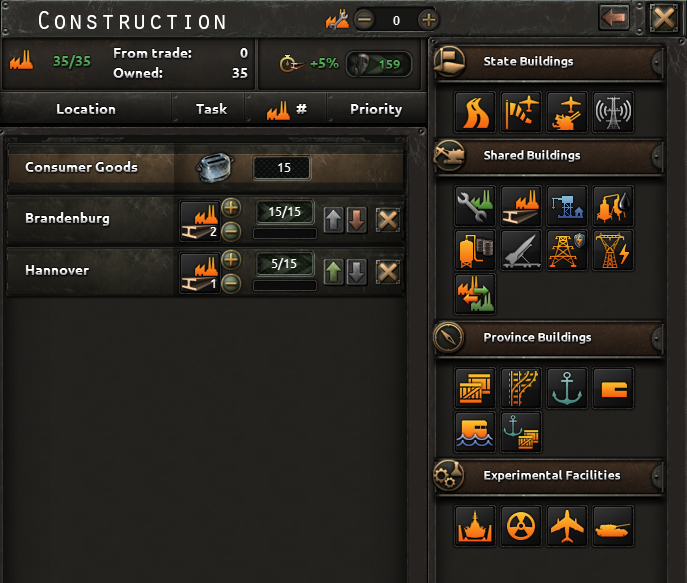
Production and construction get mixed up easily but they're not the same thing: production makes equipment with the factories you already have, construction builds the factories themselves, along with infrastructure and defenses. It's the queue that decides how much you'll grow, not how much you'll fight.
The Real Cost of Every Building
With construction costs this different from each other, not every building pays for itself at the same speed:
| Building | Cost (CP) | Note |
|---|---|---|
 Civilian factory Civilian factory | 10,800 | Produces consumer goods and constructions; also funds trade or intelligence agencies |
 Military factory Military factory | 7,200 | Produces military equipment; its output depends on production efficiency |
 Naval dockyard Naval dockyard | 6,400 | Builds and repairs ships; unlike the other factories, it runs at 100% from day one |
 Infrastructure Infrastructure | 6,000 | Multiplies the construction speed of everything else in the state |
 Air base Air base | 1,250 | Bases and repairs aircraft; each level holds 200 air units |
 Anti-air Anti-air | 2,500 | Each level cuts bombing damage by −12% and enemy air superiority in the region by −5% |
 Radar station Radar station | 3,375 | Detects enemy aircraft and ships in the area, and can boost your intelligence on other nations |
 Rocket site Rocket site | 6,400 | Stores and launches ballistic missiles; each level adds +100 capacity |
 Synthetic refinery Synthetic refinery | 14,500 | Produces synthetic fuel and rubber depending on your technology — see self-sufficiency |
 Fuel silo Fuel silo | 5,000 | Stores +100,000 fuel per silo; keeps you from running dry if a blockade or bombing run cuts your production |
 Reinforced electrical grid Reinforced electrical grid | 12,000 | Cuts factory energy consumption in the state by −7.5% per level of infrastructure; mutually exclusive with the high-capacity grid |
 High-capacity electrical grid High-capacity electrical grid | 12,000 | Boosts resource gain by +10% per level of infrastructure; mutually exclusive with the reinforced grid |
 Nuclear reactor Nuclear reactor | 30,000 | Produces nuclear bombs over time; by far the most expensive, only pays off for large nations with basic industry already covered |
 Fort Fort | 500 + 500 × current level | Each level imposes a −15% attack penalty on whoever attacks that province; gets pricier with every level already built |
 Coastal fort Coastal fort | 500 + 500 × current level | The same −15% penalty per level, but against amphibious landings and strait crossings |
 Naval base Naval base | 5,000 + 1,000 × current level | Hosts fleets and handles supply convoys; connected to a supply hub it adds +20% resources to the state |
 Railway Railway | 170 + 130 × current level | Transports supplies from the capital and speeds up your divisions' strategic redeployment |
 Supply hub Supply hub | 20,000 | Distributes supplies from railways; like the naval base, when connected it adds +20% resources to the state |
 Naval Engineering Facility Naval Engineering Facility | 12,000 | Only one per state; employs a Naval Engineering scientist to speed up that research branch |
 Nuclear Research Facility Nuclear Research Facility | 15,000 | Only one per state; employs a Nuclear Research scientist to speed up that research branch |
 Aerodynamics and Avionics Facility Aerodynamics and Avionics Facility | 12,000 | Only one per state; employs an Aerodynamics and Avionics scientist to speed up that research branch |
 Land Warfare Facility Land Warfare Facility | 12,000 | Only one per state; employs a Land Warfare scientist to speed up that research branch |
With that in mind: infrastructure first in the states that already concentrate your industry, since the time saved applies to everything you build there afterward. Dockyards if you're building a fleet, forts only on the border provinces you'll actually have to defend — not the whole border on principle — and air or naval bases wherever you'll operate on a sustained basis, not wherever "might come in handy someday." Experimental facilities are worth it mainly if you already have a spare scientist with nothing assigned — they're not that expensive and they speed up whichever branch you actually need.
Why It Matters
Every civilian factory that isn't producing equipment or eaten up by trade is free to build: new factories, infrastructure, dockyards, forts, airfields, naval bases, or nuclear reactors. That's the usual trap for new players — pouring all your industry into tanks from minute one, without setting anything aside to build the factories that would give you more production a year down the line.
Construction Speed: the Real Formula
A state's construction speed gets multiplied by 1 + (state infrastructure ÷ 5), on top of the bonus stacked from technology, national spirits, some trade laws, and, if you have Arms Against Tyranny enabled, the temporary boost the international market gives you when you sell equipment. In concrete terms: a state at infrastructure 3 out of 5 already multiplies its construction speed by 1.6x from that alone, before any other bonus. None of that replaces having more civilian factories — speed multiplies what you already invest, it doesn't stand in for it.
How Much You Can Build at Once
Here's a common mix-up: it's not infrastructure that decides how many projects you can run at once in a state — it's the state's category (from wasteland or enclave, with 0 slots, up to megalopolis region, with 12). Technology adds percentage bonuses to those slots and some national focuses grant extra slots outright, but the total is capped at 25 slots per state no matter what. Infrastructure doesn't give you more parallel projects — it makes each one go faster, which is the previous section.