
Don't confuse it with the resource trade tab: the international market, added in Arms Against Tyranny, is where nations buy and sell military equipment from each other — not steel or oil. It's the outlet that was missing for those 200 units of obsolete equipment you haven't touched in months.
Why It Matters
Without the international market, your spare equipment just piles up in storage or gets scrapped. With it, that surplus becomes something another nation needs and you can charge for — and if you're the one buying, it's the fastest way to patch a sudden equipment shortfall without pulling factories off production you already have running.
 Market Access
Buying from or selling to another nation requires market access with them, a mutual agreement that's negotiated automatically by default but can be switched to manual in your market settings. Opinion and ideology decide whether the AI agrees; declaring war or an embargo between the two sides cancels access instantly, along with any active contracts. Between members of the same faction, or between a subject and its overlord, access is automatic and full.
Buying and Selling
To buy, you open the market tab and browse the list of equipment other nations have put up for sale: each listing shows the seller's flag, the exact equipment, how many units are available, and its price. Picking something opens a purchase draft where you decide how much you want, the payment terms, and how it gets delivered. Every  civilian factory you assign to the purchase pays its share.
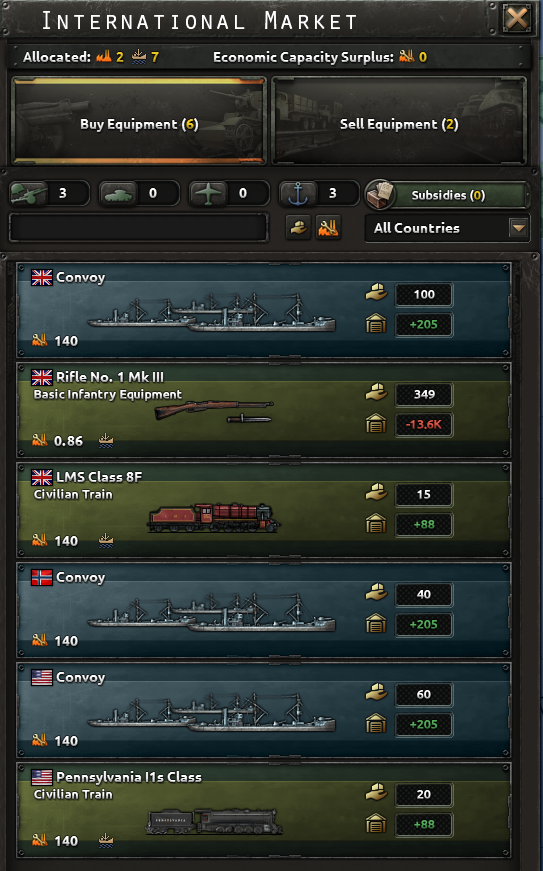
Above the list you can filter by equipment type (land, armor, air, naval) and by seller country, and see at a glance how many civilian factories you have assigned to active purchases and sales right now.
Selling is the same process in reverse: you click "Add Equipment to Market," pick what surplus you're putting up for sale and at what price, and from the same tab you can pull any active listing if you change your mind.
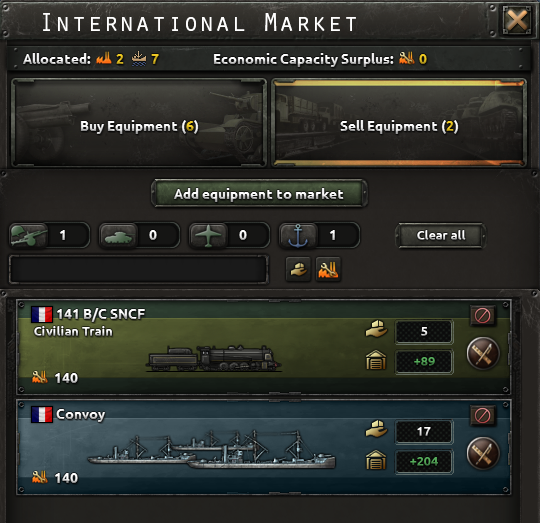
Every listing you put up for sale stays here until someone buys it or you pull it yourself.
 The Surplus That Fuels Your Construction
The currency on this market isn't real money — it's Economic Capacity Surplus (ECS), generated by the civilian factories you assign to each sale. That ECS turns into a temporary boost to your active construction lines' speed — a default +25%, which your trade law shifts to roughly +22.5% to +27.5% — and it drains as construction uses it up, until it hits zero.