
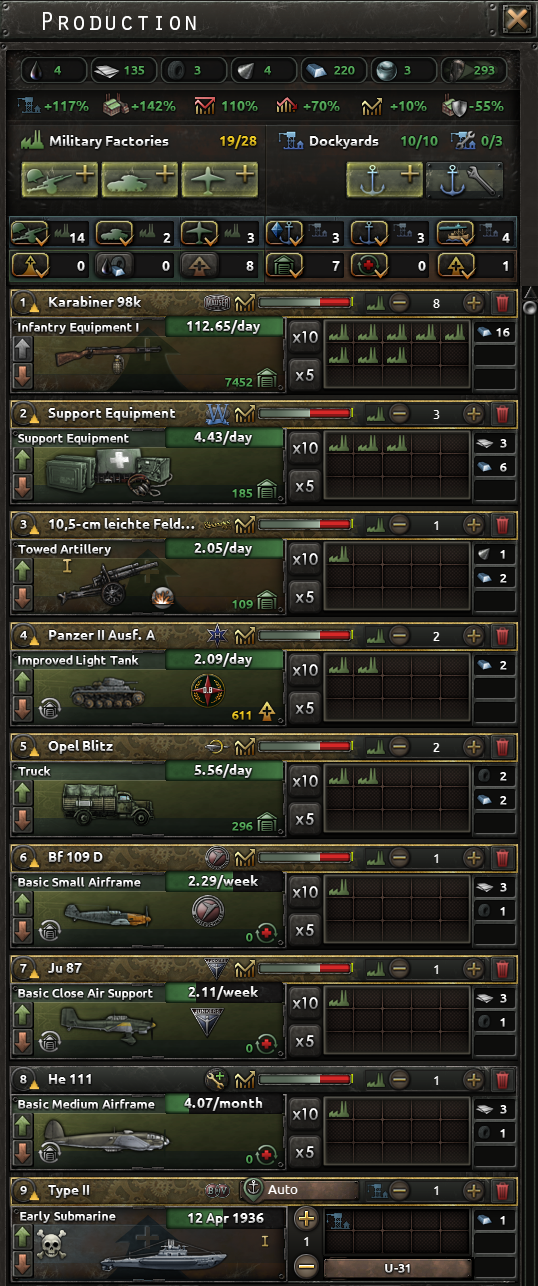
Production decides more games than combat itself, and it gets decided long before the first shot is fired. Understanding the real efficiency formula, the three retention tiers when switching lines (not a simple "90% or 10%"), and when a production license is actually worth it puts you ahead of the ninety percent of players going by feel.
Three Factory Types, Zero Interchangeability
Each factory makes one thing and only that thing, so the ratio between them defines what kind of country you're actually building. Up to 150 factories can be assigned to a single production line, and for ships the limit is even stricter: a maximum of 5 dockyards per capital ship line, 10 for screens and submarines, 15 for convoys, and 5 for floating harbors.
 Civilian: construction, trade, consumer goods, and equipment licenses bought from other countries. Base 4/day, 5/day with coal and electricity available.
 Military: rifles, artillery, planes, trains — all land and air equipment. Base 3.5/day, 4.5/day with coal. This value is multiplied by both factory output modifiers and by production efficiency itself, independently of each other.
 Dockyards: ships, submarines, convoys. Base 2/day, 2.5/day with coal. Unlike the other two, they run at full output from day one — production efficiency doesn't affect them at all.
The Efficiency Curve and Its Real Formula
Every military production line starts at 10% efficiency (with no modifiers) and climbs each day toward a 50% cap (also with no modifiers; both values improvable with technology and focuses). The daily gain isn't a fixed number — it follows this formula: 0.001 × (efficiency cap)² ÷ current efficiency. In practice, this means the minimum daily gain is around 0.05% (near the base 50% cap) and the maximum is around 1% (with a 100% cap, starting from 10%) — meaning the higher your efficiency cap, the faster you climb early on.
The Three Retention Tiers When Switching Lines
Switching a production line isn't a simple "you lose all the efficiency or almost none" — there are three tiers depending on how drastic the change is, and it's worth knowing them before touching the equipment designer:
- 90% retained — a different variant of the same model (e.g. Panzer III Ausf. F → Ausf. G), including switching from license production to your own design of the same equipment type.
- 70% retained — a different model on the same chassis (e.g. Panzer III → StuG III, the tank destroyer on the same chassis).
- 30% retained — a direct upgrade or downgrade of the same equipment type (e.g. Panzer III → Panzer IV).
These percentages improve with the Dispersed Industry technologies (levels I-V) and Flexible Line, and with certain national spirits and political advisors. Important: switching back to the previous line does not undo the loss — retention is calculated purely between the equipment you're currently producing and the equipment you're switching to, not based on your history. So the underlying advice stays the same: settle on a design deliberately and stick with it long enough to earn back the accumulated efficiency, instead of redesigning every time a new part shows up in the designer.
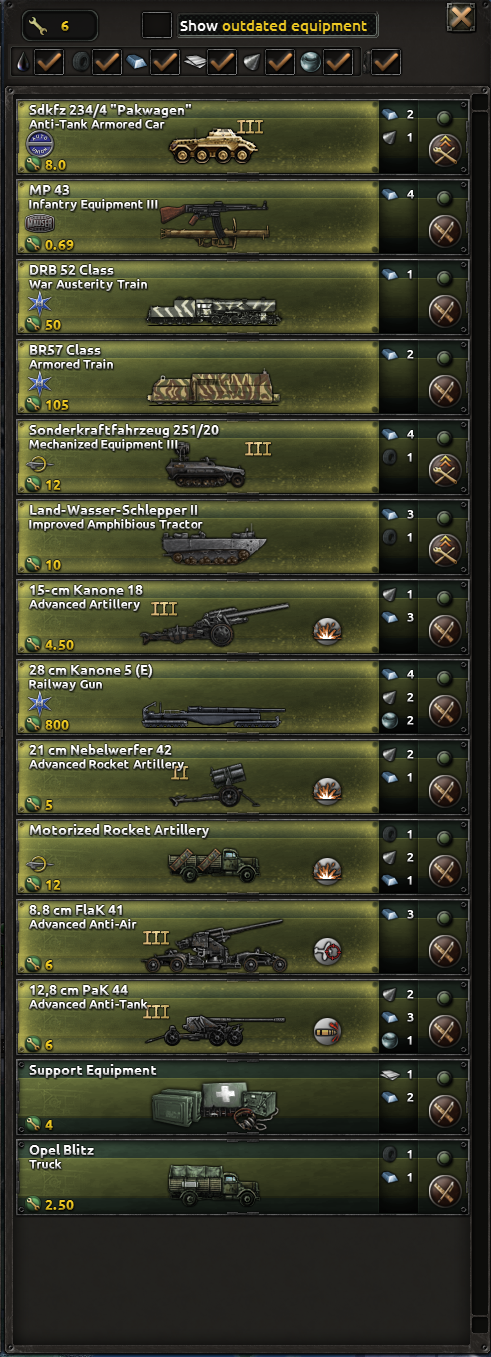
This is what the catalog looks like when adding a new line: the roman numerals next to each name (III, II...) mark the variants these retention percentages are calculated between.
Production Licenses: When They Pay Off
Paying another country for a license to produce their equipment costs 1 civilian factory for 1936-era technology or earlier, +1 civilian factory for each year of technology past 1936 (a 1939 artillery license costs 4, a 1942 one costs 7). In exchange, holding the license gives you +20% research speed toward the domestic version of that same equipment.
The catch is that producing licensed equipment never performs as well as your own design — the penalties apply multiplicatively on top of production:
- −25% if the license comes from a member of your own faction.
- −35% if it comes from a country outside your faction.
- −50% if you don't even hold the license ("pirated" production).
- Up to −20% additional if the licensed equipment is ahead of your own technology (−5% per year ahead).
The practical takeaway: a license from an ally within your own faction is a cheap, reasonable way to plug a production gap short-term while your own tech catches up — but keeping it as a long-term plan leaves you producing at a noticeably worse rate than your own dedicated factories.
The 7 Strategic Resources
Without access to these, you're not building anything. Short on one, and the line that needs it underperforms — down to -100% on your lowest-priority factories.
 Oil: refined into fuel for ships, planes and vehicles.
 Aluminum: planes and support equipment.
 Rubber: planes and motorized or mechanized units.
 Tungsten: anti-tank guns, heavy armor, medium and heavy tank guns.
 Steel: the most universal one — infantry, artillery, tanks, ships, trains.
 Chromium: advanced engines, armor plating, modern tanks and ships.
 Coal: doesn't go into equipment directly, but feeds the output of every other factory.
Where Value Gets Lost
The costliest one: building military factories like crazy before your civilian base can support them, then redesigning equipment every couple of months and torching accumulated efficiency — remember that even a "direct" upgrade of the same equipment only retains 30%. The second is relying on production licenses as a long-term plan instead of a temporary patch, eating a −25% to −50% performance hit indefinitely. Civilian factories first, commit to a design after, and leave it alone.