
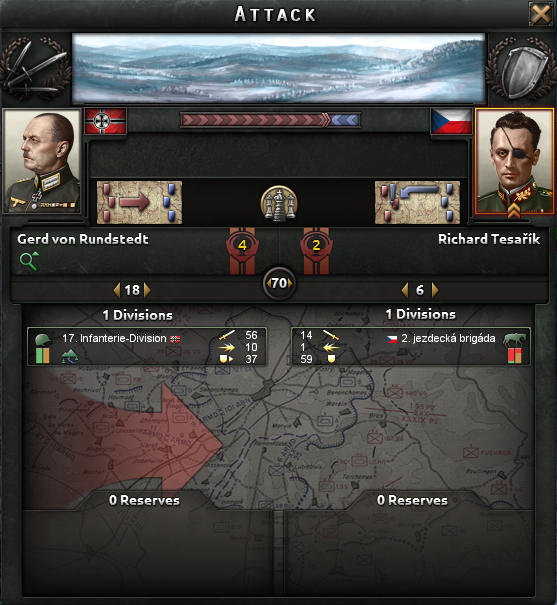
This is the mechanic that trips up newcomers to Hearts of Iron IV more than any other, and the one worst explained out there — usually with a list of "recommended" numbers and no explanation of where they come from. Here are the real per-terrain figures and the mathematical reason the community converges on 20 or 40-width templates.
What Combat Width Is
Every division occupies a "width" in battle based on its battalions: most battalions are worth 2 width, artillery (including motorized and self-propelled) is worth 3, anti-tank and anti-air battalions (including motorized) are worth 1, and support companies take up no width at all. Each province has a maximum battle width per side, and divisions that don't fit sit in reserve waiting for room — not fighting or losing organization, but not contributing either.
The Real Width of Every Terrain
Base battle width depends on the terrain the fight is happening on, and it expands if you attack from multiple provinces at once (flanking) — each flanking direction adds another 50% of the base width. Here are the real values (base width + the flanking bonus in parentheses):
 Urban: 80 (+40 flanking) — the widest of all, but with −30% attack and −50% against enemy air superiority.
 Plains: 70 (+35) — no attack penalties.
 Desert: 70 (+35) — +15% equipment attrition.
 Hills: 70 (+35) — −25% attack.
 Forest: 60 (+30) — −15% attack, −10% against enemy air.
 Jungle: 60 (+30) — −30% attack, +20% attrition.
 Marsh: 50 (+25) — −40% attack, +35% attrition.
 Mountain: 50 (+25) — the narrowest and most punishing, −50% attack.
One detail that gets lost in almost every guide: battle width can be exceeded up to a point without extra divisions getting shut out entirely. The penalty is calculated as −100% × (total width − battle width) ÷ battle width, and divisions keep joining combat as long as that penalty doesn't exceed −33%. For example, an 80-width Urban battle can hold up to 106 total width (a −32.5% penalty) but not 107.
Why 20 or 40 Width, and Not Some Other Number
Look at the terrain widths above: 50, 60, 70, and 80. They're all multiples of 10 — and that's exactly why the community has converged on 20 or 40-width templates instead of any other number. A 20-width division fits exactly into most of those battle widths: 4 divisions fill an 80-width front and 3 fill a 60-width one, with nothing wasted. On the 50 and 70 widths you're left with one spare division either way, but the overstacking allowance of up to −33% absorbs that mismatch cheaply (4 divisions of 20 on a 70-width front only costs a −14% penalty). A division at, say, 18 width leaves leftover slack on almost every terrain (70÷18 = 3.9, meaning only 3 full divisions fit with unused room left over).
40 width follows the same logic but for bigger templates with more support (more support companies, which take up no width, fitting inside a larger division). Neither one is "the correct" width in some absolute sense — they're simply the ones that divide the game's actual terrain widths most cleanly.
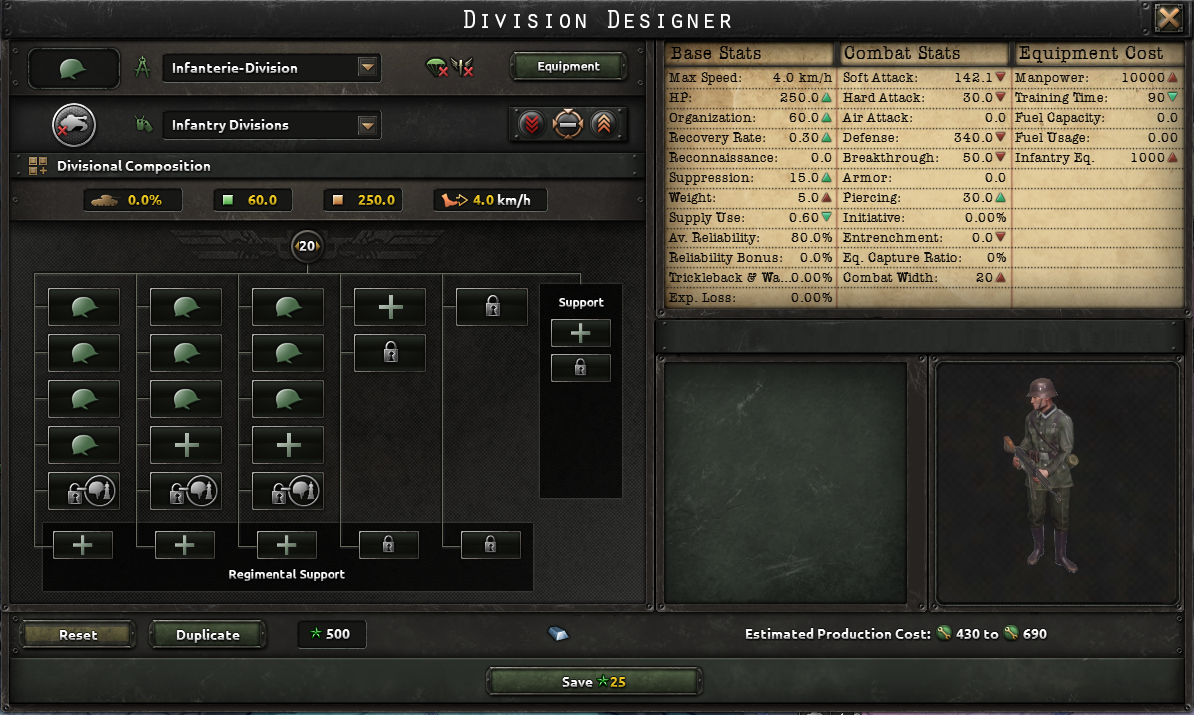
A standard 9-battalion infantry division already lands right at 20 width — the classic cheap template meant to be repeated by the dozen across the whole front.
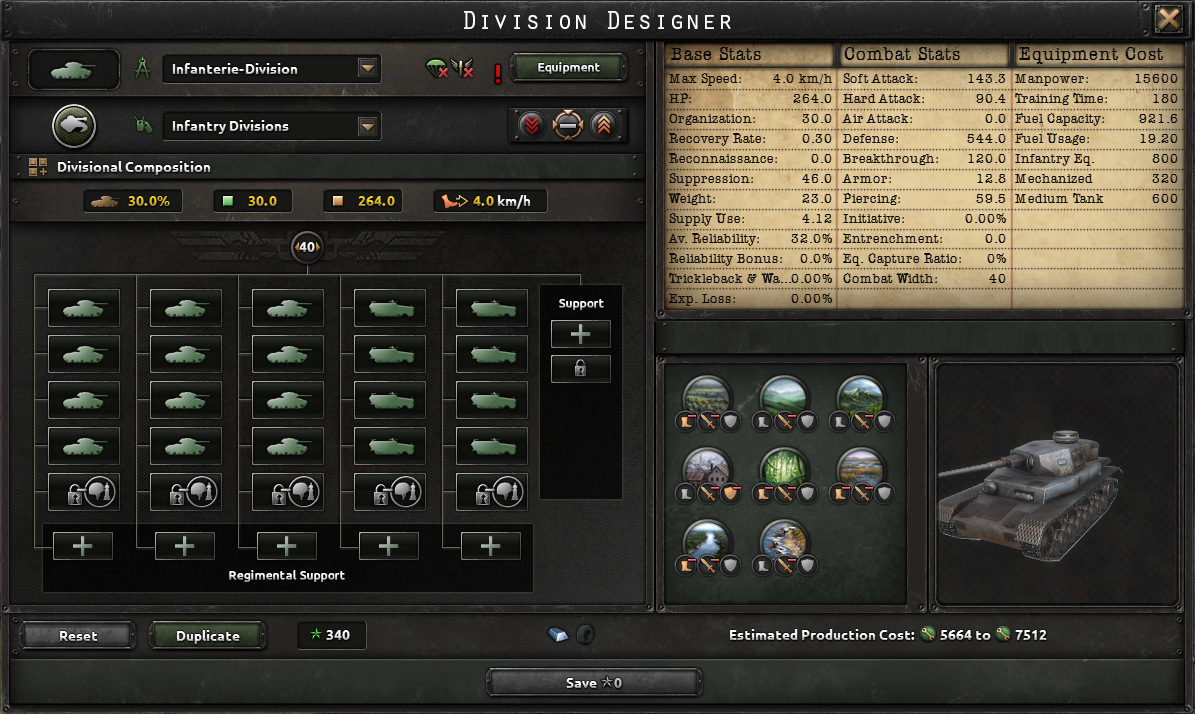
40-width templates, on the other hand, are almost always armored: unlike cheap infantry, you don't need or want dozens of these divisions — they cost far more in factories and scarce resources like tungsten or chromium — so there's no downside to packing twice the battalions into one large template instead of spreading the same armor across twice as many 20-width divisions. A handful of 40-width divisions already gives you enough breakthrough power for the one spot where you're actually going to attack.
What Happens to Divisions That Don't Fit
Divisions in reserve don't attack, don't take damage, don't recover organization, and don't build up entrenchment — but they do provide recon and anti-air capability. Each hour, a reserve division has only a 2% chance of joining combat if room opens up (an average wait of about 50 hours), though that chance improves considerably with radio technology, division speed, doctrine tech, and an attached signals company. If you're attacking, avoid sending more divisions than fit in the available width — the extras are better left out gaining organization and the planning bonus instead of sitting idle in reserve.
Two Templates to Start With
Skip the hunt for "the perfect template" with an external calculator before your first game. Two clearly distinct 20-width templates cover you fine:
- Cheap shield: infantry (10 battalions at 2 width each) + engineers + support artillery, 20 width. Holds the front without burning expensive resources or military factory time.
- Expensive sword: tanks or special forces, also close to 20 width so it slots into the same front cleanly. Used at the one point where you want to break the enemy line, not spread across the whole front.
The logic is simple: cover kilometers of front cheaply with the shield, and save the expensive spending — tanks, special equipment — for the single stretch where you're actually attacking.