
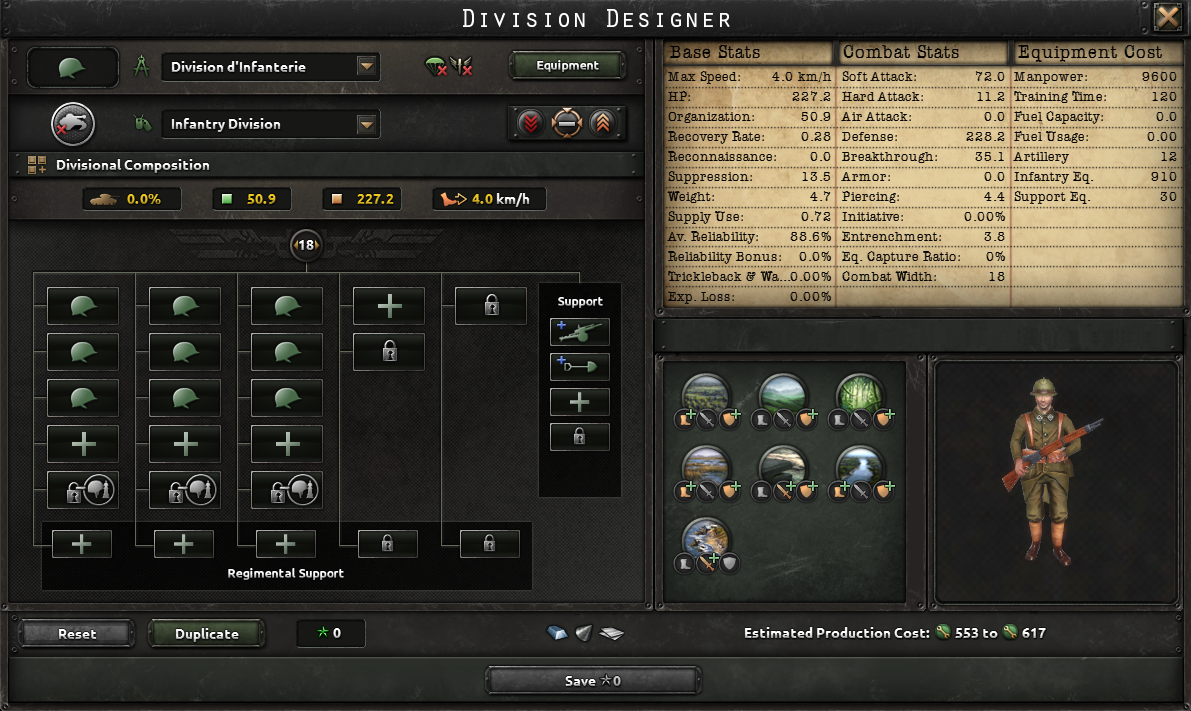
Every division you deploy comes out of a template: the mold that defines how many battalions it carries, of what type, and with what support. The division designer looks intimidating the first time you open it, but underneath it only manages three things: which combat battalions you put in, which support companies you add, and how much army experience each change costs.
What a Template Is and How It's Organized
Every template has up to 5 combat regiments, and each regiment up to 5 battalions — a maximum of 25 combat battalions per division —, plus up to 5 different support companies (only one of each type). Each template can also be marked as elite, regular, or reserve: when limited equipment gets distributed, elite units get priority, then regular ones, and finally reserves — so it's worth saving the elite label for the divisions you actually want to receive the newest equipment first.
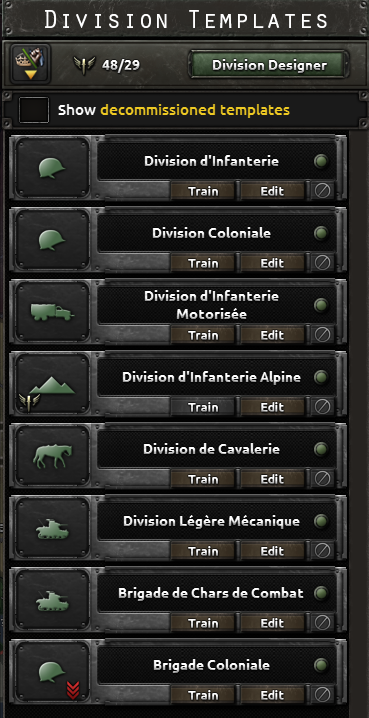
When you modify an existing template, every division using it automatically orders whatever equipment and manpower it's missing, and returns any surplus to the national stockpile. Because of this, it's worth having that surplus ready in your stockpile before touching the template of divisions that might see combat soon, and it can pay off to upgrade divisions one at a time rather than all at once if remaining equipment is limited. If you're left with divisions below full strength, the Army window has a consolidation button to merge several understrength divisions of the same template into a full one, as long as they're independent of any command.
Combat Battalions and Support Companies
Every combat regiment is made up entirely of a single battalion type — you can't mix types within the same regiment — and there are three:
 Infantry — line infantry, special forces, towed artillery/anti-air/anti-tank.
 Mobile — cavalry, motorized and mechanized infantry, motorized artillery (including rocket artillery), armored cars.
 Armored — tanks, tank destroyers, self-propelled artillery, amphibious tanks.
Support companies are different: unlike an artillery, anti-air, or anti-tank battalion placed inside a combat regiment, a support company doesn't slow the division down or take up combat width — with the exception of recon companies, which do affect speed because they set the whole division's top speed and depend on their own equipment to perform at their best. Some of the most useful ones:
 Engineer — raises entrenchment and helps assault forts and cross rivers.
 Recon — improves reconnaissance (better countering enemy combat tactics) and speed in difficult terrain.
 Military Police — raises suppression against partisans; with 2-6 minimally-equipped cavalry battalions it makes a very cheap rear-area security division.
 Maintenance — raises equipment reliability, recommended for divisions using expensive equipment like tanks.
 Field Hospital — recovers more lost manpower and reduces experience loss from casualties; useful for front-line divisions.
 Logistics — reduces the whole division's supply consumption.
 Signal — raises initiative, speeding up planning and the chance of reinforcement from reserves in combat.
 Support Artillery — a smaller soft attack bonus than a line artillery battalion, but without slowing the division or taking up width.
 Support Rocket Artillery — similar, but also gives a breakthrough bonus.
The Experience Cost of Each Change
Modifying a template can cost army experience, but not every change costs the same:
- Duplicating a template, changing its equipment, name, icon, or priority — free.
- Adding a regiment of a type already present in the template — 5 XP (includes the first battalion).
- Adding a regiment of a type new to that template — 25 XP (includes the first battalion).
- Adding, removing, or swapping a combat battalion — 5 XP (removing the last battalion in a regiment removes the whole regiment).
- Changing a battalion's type to one already present in the template — 5 XP per battalion.
- Changing an entire regiment's type to a new one — 25 XP + 5 XP per battalion.
- Adding, removing, or swapping a support company — 10 XP.
Combat Width: Why Bigger Isn't Always Better
Doubling a template's battalions (say, going from 20 to 40 combat width) doubles soft attack, hard attack, defense, and breakthrough points, since those stats are additive. But organization doesn't double — it's the average of the included battalions' organization, not the sum —, so a division twice the size isn't twice as resistant to damage, it just has twice the HP.
In combat, only 10% of attack points count while enemy defense is still holding them back, but that jumps to 40% once defense is exhausted. A large division drains that defense in a more concentrated way (with less randomness) than two equivalent smaller divisions, which makes it better at breaking through lines. In exchange, smaller divisions are more versatile — you can maneuver more units to cover an extended front or pull off an encirclement — and they fit more support companies per unit of equipment invested.
That explains why each width pays off, but not where those specific numbers come from — for that, the combat width file breaks down the real width of each terrain and the math behind why 20 and 40 fit better than any other number.
Common Mistakes
- Changing the template of front-line divisions without having the equipment and manpower surplus ready first — the division stays partially unequipped until the new supply arrives.
- Not realizing that mixing in a new battalion type costs an extra 25 XP, not just the normal cost of adding a battalion.
- Doubling a template's width thinking it makes it twice as resistant — it only scales HP and attack, not organization.
- Ignoring artillery/anti-air/anti-tank support companies assuming they give the same as a line battalion — they give a smaller bonus, but in exchange don't take up combat width or slow the division down.