
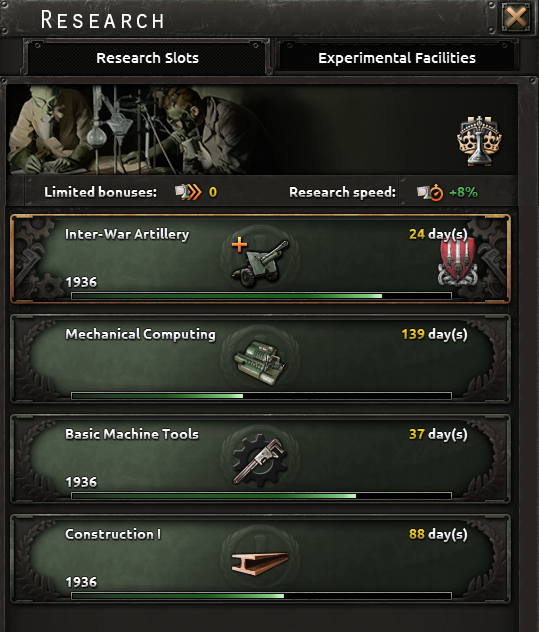
Research decides what equipment you can build and which bonuses you have access to, but the real bottleneck is almost never what to research — it's how many slots you have and how much it costs you to get ahead of the date a technology "belongs" to. That penalty has a concrete formula, and it's surprisingly harsh.
Why It Matters
Every empty research slot is wasted time: with only 2 or 3 slots at the start, choosing the wrong thing to queue can leave you months behind a rival who knew exactly what to prioritize. And since every technology has a "natural" year attached to it, researching it early isn't free — it has a measurable cost in research speed, not just a difficulty label.
How Many Slots You Actually Get
By default, a minor European country starts with 3 research slots and a non-European one with 2; major powers ( Germany, the
  USSR, the
  United States, the
  United Kingdom,
  Japan...) start with more than that baseline. On top of that, you get between 1 and 3 additional slots depending on the country, unlocked through its national focus tree. The real count of how much you can research in parallel isn't "whatever the game ships with" — it's that base plus whatever your focus tree gives you, so a country with few research-related focuses has a much lower ceiling than it looks at first glance.
 The Ahead-of-Time Penalty: the Real Formula
Every year you research a technology before its "natural" year adds a fixed ahead-of-time penalty. In concrete numbers: researching something one year early multiplies that technology's research speed by 1/3 — meaning it takes roughly triple the time it would take researched on schedule. And here's the part most people don't know: regular research speed bonuses ( industry, advisors,
  radio technologies) do not reduce this penalty. Only the specific ahead-of-time bonuses that some national focuses grant actually mitigate it — for example, a +50% ahead-of-time bonus turns that 1/3 into 2/5.
 Sharing Technology Within a Faction
When you cooperate on research with other countries (inside a faction or a tech-sharing agreement), you get a research speed bonus for every other country in the group that has already unlocked that same technology, up to a maximum cap. In practice, this is what makes researching inside a bloc of puppets or allies go much faster than going it alone for whatever technologies the faction leader already has: you're not researching it from scratch, you're sharing it.
When Getting Ahead Actually Pays Off
Paying the ahead-of-time penalty makes sense when it's targeted: one or two specific technologies that unlock a critical bonus or focus, not a blanket rush across the whole tree. The usual mistake is trying to run a year or two ahead on everything at once — since the penalty is multiplicative and applies technology by technology, getting ahead on several lines at the same time multiplies the total cost instead of adding it up, and the cumulative effect usually eats up whatever edge you were chasing.