
Every nation has a focus tree: long-term strategic decisions that define which path the country follows, historical or alternate. Before you even stop to think about which focus to pick in your own game, it helps to understand how the system itself works — something almost no guide explains because it assumes you already know it.
How Focuses Unlock: Prerequisites and Mutual Exclusion
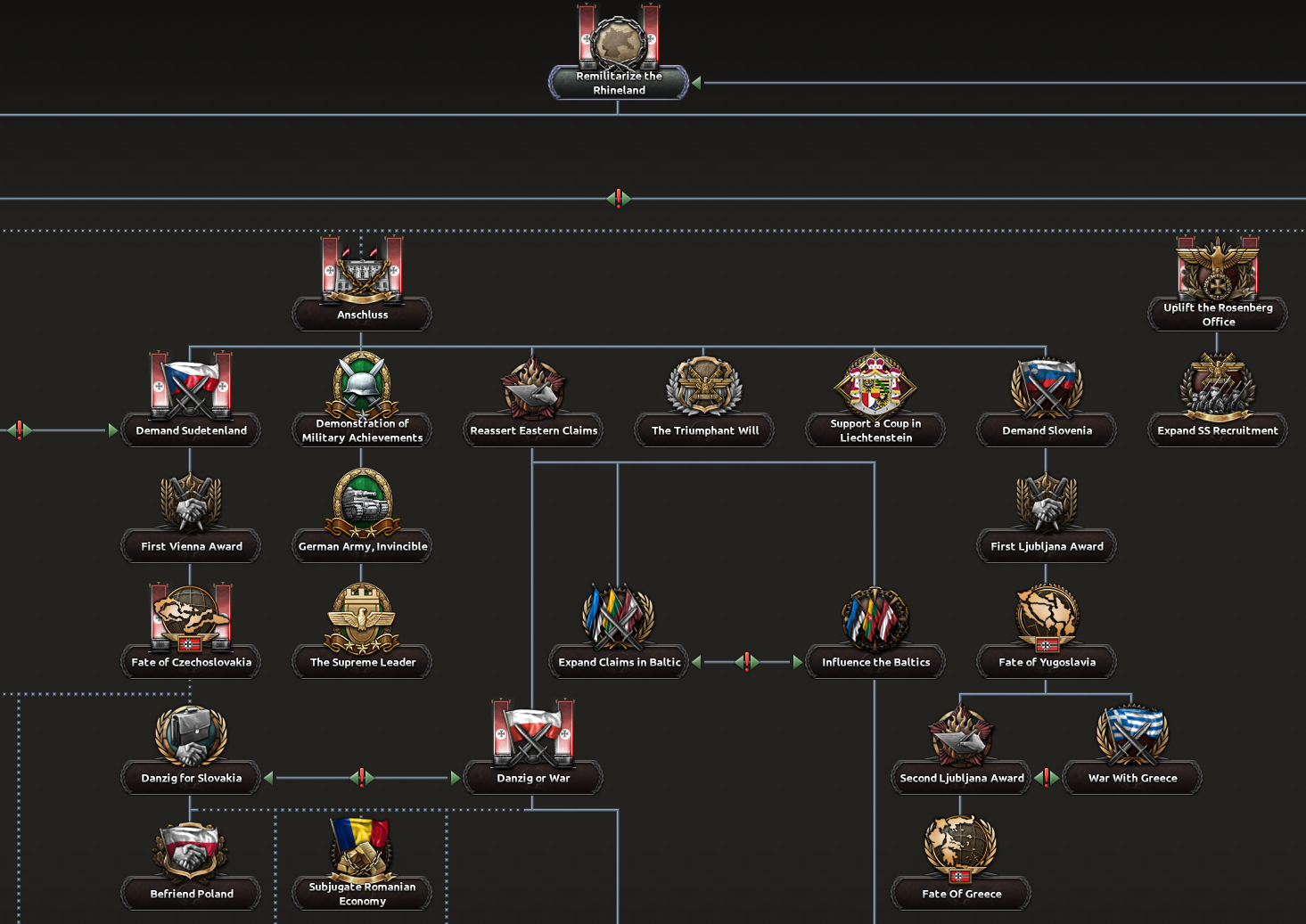
Focuses are connected by colored lines: a green line means that prerequisite is already completed, light blue means it isn't yet. A solid line means you need all the focuses it connects (a logical AND); a dotted line means one of them is enough (a logical OR). In the screenshot above, for instance, "Demand Sudetenland" and "Uplift the Rosenberg Office" only need "Remilitarize the Rhineland" completed first.
The mutually-exclusive icon (the red-and-green diamond between two focuses) means you can only ever pick one of the two in a given playthrough — and that exclusion can cascade down the entire branch hanging off each side until both paths converge again. You can see it twice in the screenshot: between "Danzig for Slovakia" and "Danzig or War," and between "Expand Claims in Baltic" and "Influence the Baltics." Picking one of those paths closes the other off for good in that game.
 The Real Cost: Days and Political Power
You can only have one focus active at a time, and its cost in political power equals exactly the number of days it takes: a 70-day focus costs 70 political power, a 35-day one costs 35, at a rate of 1 political power per day while it's running. No discounts, no surprises — the number shown on the focus itself is the total spend.
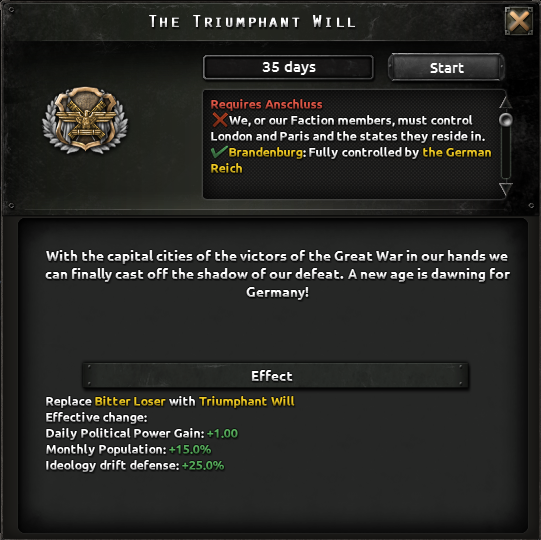
In the example above, "The Triumphant Will" takes 35 days (35 political power) and, on top of the tree's own prerequisite (Anschluss), demands an extra condition you won't see in the arrows: that Germany or its faction controls London and Paris. On completion, it swaps the "Bitter Loser" national spirit for "Triumphant Will," with its own permanent bonuses. One detail that's easy to miss: if you finish a focus and take up to 10 days to pick the next one, that time (and the political power already banked) isn't wasted — it still counts toward whichever focus you pick after.
Switching Focus Halfway Through Is Expensive
You can stop a focus in progress at any time, but only up to 10 days of progress get saved — if you've put in 20 days and cancel, you lose 10 with no way back. Worse still: if a requirement of an already-started focus stops being true and can't be restored, the focus gets cancelled outright and every bit of political power already spent just disappears. So it's worth checking the requirements carefully — and how likely they are to change over the time the focus takes — before you commit, not halfway through.
What a Focus Can Give You
What each focus grants varies from nation to nation, but the categories repeat: it changes or adds national spirits (with permanent or temporary effects, like in the example above), unlocks new decisions, hands out free equipment or resources, grants territorial claims or a straight-up war goal against another country, or unlocks entire branches of the tree that weren't even visible before.
The Generic Tree: for When Your Nation Doesn't Have Its Own
Don't assume you'll be stuck with the generic tree: after years of country packs (La Résistance, Battle for the Bosporus, No Step Back, By Blood Alone, Arms Against Tyranny, Trial of Allegiance, Graveyard of Empires, Poland: United and Ready...), most nations with any real weight — and pretty much every one a player would actually pick out of interest — already have a custom-built focus tree. The generic one has been pushed down to genuinely minor nations, and it still works as the fallback tree for any DLC nation if you don't own that specific expansion. Still worth knowing, since its 5 branches sum up the same logic that most custom trees end up repeating anyway:
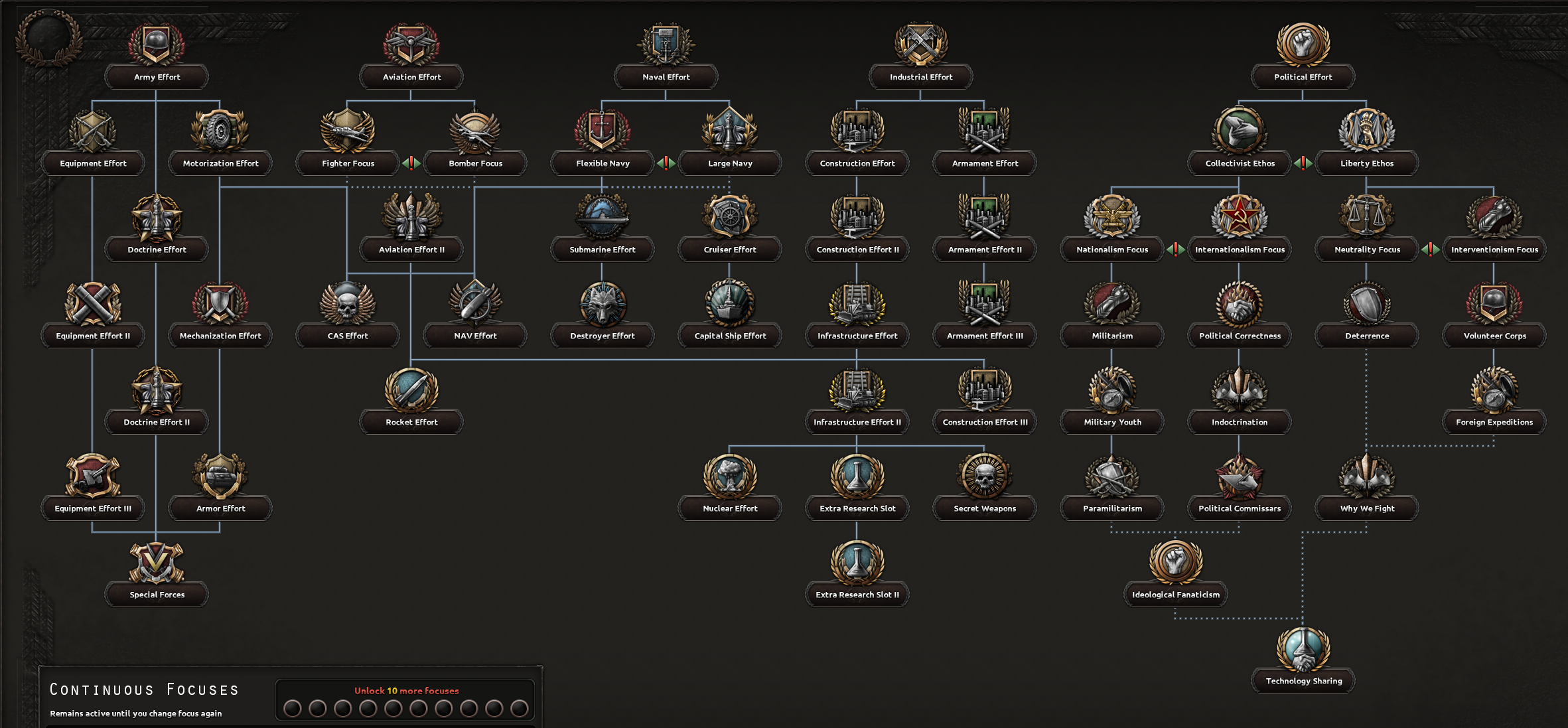
- Army Effort — army experience and land research bonuses.
- Aviation Effort — the same idea for aviation: air experience and research bonuses.
- Naval Effort — the same logic applied to the navy.
- Industrial Effort — builds civilian and military factories and infrastructure, ending in two extra research slots.
- Political Effort — the only one with real ideological forks, defining which way your country drifts.
Continuous Focuses
Completing 10 regular focuses unlocks continuous focuses (9 in total). Unlike a regular focus, which gives a one-time effect on completion, a continuous focus keeps its bonus active for as long as it stays selected, in exchange for a maintenance cost of 1 political power per day — and it occupies the single focus slot just like a regular one. You can deactivate it or swap it for another at any time at no extra cost, so it's not as costly as it sounds if you need that slot back for a regular focus later.
 Which Focuses to Prioritize First
If your goal is simply to grow as fast as possible before the war arrives, two types of focus almost always pay off more than anything else, whatever nation you're playing: the ones that boost research speed or add extra research slots, and — especially early in the game — the ones that improve your industry, particularly civilian industry.
This holds whether you've got the generic tree or — far more likely these days — a nation's own unique tree: prioritize civilian-industry and research focuses ahead of the purely military, rearmament, or political ones, and leave doctrine or diplomacy for once your economic base is already built. A country that supercharges its industry in the first couple of years shows up to the war with far more room to work with than one that chased flashy decisions from minute one.
In practice, look for the branch in your own tree that hands out civilian factories, infrastructure, or research slots — it usually has a name tied to industry, construction, or the economy — and treat it as a higher priority than everything else, whatever that specific nation happens to call it. (Just as an example: on the generic tree that branch is "Industrial Effort," with focuses like "Construction Effort" or "Extra Research Slot.") Every extra civilian factory and every extra research slot pays itself back over the rest of the game, so the sooner you grab them, the longer they have to earn out what they cost.