
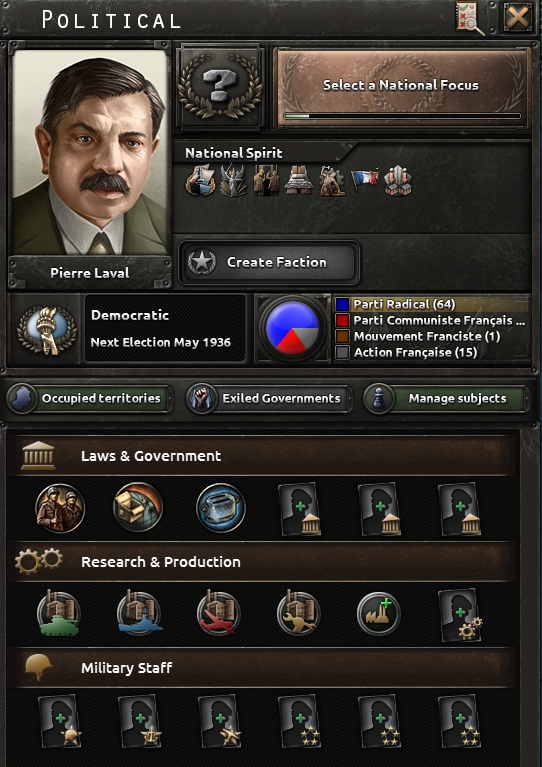
Every country runs its domestic politics on a single currency: Political Power (PP). You spend it to activate focuses, change laws, manage parties and national spirits, appoint political and military staff, and pull the levers of diplomacy — and since you generate it slowly and in limited amounts, a good chunk of the game comes down to deciding what to spend it on first.
Why It Matters
Political power is the least flashy resource in the game, but probably the most limiting one: factories, divisions, or ships usually arrive before the PP needed to unlock them politically. Understanding how it's generated and what eats up most of the spending is the difference between having room to react mid-game or running dry right when you need it most.
 Political Power: What You Actually Generate and Where It Goes
You generate +2 PP per day on Regular difficulty (more on Civilian or Recruit, less on Veteran or Elite), and the total you can store is capped between -500 and 2,000. Your country's stability also affects the generation rate: at 0% stability you generate 50% less, at 100% you get a 20% bonus, and at 50% there's no modifier at all. Most of that PP goes to two places by far: the national focus tree (1 PP per day while a focus is running) and "ideas" — laws, staff, and design companies — which usually cost 150 PP to adopt or change. The rest gets split between diplomacy (justifying a war of conquest costs 50 PP plus 10 per state added to the justification; guaranteeing another country's independence costs 15 PP the first time and rises by that same amount each time you repeat it) and new generals or admirals (5 PP for the first one, +5 for each one you already have recruited).
The National Focus Tree
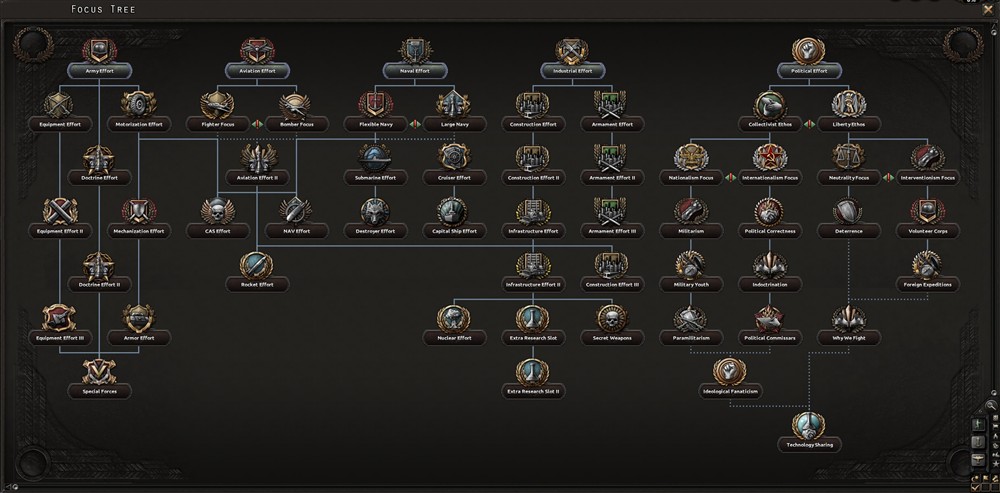
You can only have one focus active at a time, and each one takes 70 days on average (some take 35), consuming 1 PP per day the whole time. Finishing one gives you up to 10 days of leeway before you have to pick the next without losing the PP you've already banked — handy for reviewing the tree calmly instead of chaining focuses blindly the moment one finishes. The seven great powers and a handful of DLC nations get their own focus tree; everyone else uses the generic one shown below, with its five fixed branches: Army Effort, Aviation Effort, Naval Effort, Industrial Effort, and Political Effort. Before activating a focus, check its requirements: if they stop being met partway through, the focus either pauses or gets cancelled outright, and any PP already spent is lost.
National Spirits
National spirits are persistent modifiers reflecting your country's current political, social, or industrial state — from the hangover of an economic crisis to the enthusiasm of a freshly signed alliance — and they're shown as a row of icons right below the focus tree. Each one carries its own modifiers (to stability, war support, production, recruitment, research...) that stack with the rest of the country's bonuses without you having to do anything actively. Some fade away on their own or when the focus that replaces them completes; others stay for the entire game, especially the ones reflecting structural traits of the country (population size, industrial base, historical doctrine). It's worth reviewing them now and then: some carry serious penalties that go unnoticed until someone starts wondering why their economy or army is underperforming.
Political Parties
Below the focus tree, the Politics screen shows each party's support — usually four: the one in power and its three ideological rivals, with the exact labels varying by country — as a percentage that shifts slowly over time, pushed by your decisions, focuses, and events. Democracies, and some non-aligned countries, hold periodic elections every one or several years depending on the nation: if a party crosses 50% support by the time the vote comes around, it wins and becomes the new government, with whatever change in ideology, leader, and sometimes political direction that brings. Watching these percentages matters even if you have no plan to switch ideology — a strong, neglected opposition can end up taking control of the country at the ballot box, not on the battlefield.
Tied to this same screen are your political advisors: up to three slots you can fill with characters carrying their own traits (economy, propaganda, internal security...), each costing PP to appoint or replace.
Government Laws
Every country always has exactly one law of each of three types — conscription, trade, and economy — and switching from one to another costs 150 PP per level of difference between the old law and the new one, provided you meet the requirements to adopt it. The conscription law gets adjusted the most: it raises the percentage of population you can recruit, but also increases penalties to factories, dockyards, and construction speed the harder you push it — starting at "Service by Requirement," serious production cuts kick in. Most countries start on "Volunteer Only," though powers like Germany, France, Italy, the United States, or Japan begin with a more restrictive law by default.
Research and Production
This tab brings together the decisions that shape how well you design and build your equipment. Without Arms Against Tyranny, you pick up to four design companies — one each for tanks, ships, aircraft, and materiel — which grant permanent bonuses to any equipment you design or research while they're under contract; the bonus isn't retroactive, so if you switch companies, equipment already designed keeps the previous company's perks. With Arms Against Tyranny active, design companies are replaced by Military Industrial Organizations (MIOs), which work similarly but improve with use. You can also always appoint an industrial concern (electronics, industrial, railway, or refining), which adds extra research speed to its matching field.
Military Staff
Military staff covers three types of post, all costing PP to appoint or replace: a military theorist (one at most, with traits that usually push you toward a specific combat doctrine), a chief for each branch — Army, Navy, and Air Force — who provides daily experience to that branch (between +0.2 and +0.4 per day depending on their level: Specialist, Expert, or Genius), and up to three military high command posts, which give more specific global bonuses depending on their specialty. You don't need to fill them all at once — prioritize whichever post best fits your game plan (a theorist if you're about to lock in a doctrine, a naval chief if your war is going to be mostly naval) and leave the rest for when you have PP to spare.
Where People Go Wrong
The most common mistake is treating political power as if it were unlimited — activating focuses, switching laws, and replacing staff with no real order — and running dry right when a real opportunity comes up: a war to justify, an alliance to guarantee. The second is maxing out the conscription law the moment the game starts, without realizing that past a certain point you're cutting your own industrial output in exchange for manpower you might not even need yet. The third is ignoring rival parties' support because you assume elections are a formality — a strong opposition can take the country away from you if you let it grow unchecked for several election cycles in a row.