
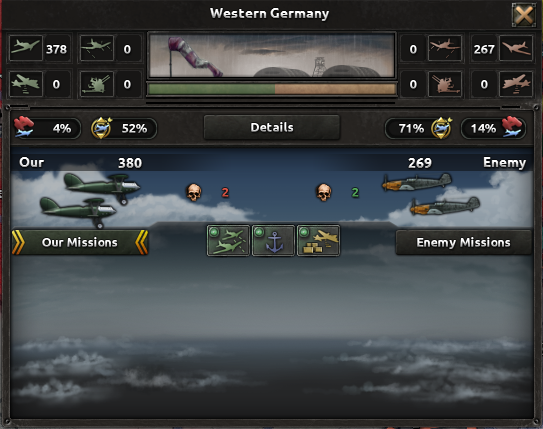
Aviation is the first thing people neglect when starting out, and the biggest multiplier for the rest of your army when used well. The key is order, and one very concrete number: every point of air superiority above 50% costs the enemy −0.7% to land defense and breakthrough, up to a maximum of −35% with full control of the sky.
Every Available Mission
Each air wing can only hold one active mission at a time, and the game lists them in this order, left to right, in the assignment panel:

 Pilot Exercises: trains the wing to gain training experience and air experience, at the cost of fuel and a higher risk of accidents; turning it on disables any other mission assigned to that wing.
 Air Superiority: air-to-air combat to seize control of a region's sky — the full breakdown is right below.
 Close Air Support (CAS): bombs enemy divisions directly in the middle of land combat.
 Interception: assigned fighters only join combat when they detect enemy bombers, transports, or scout planes — they'll also engage any fighters escorting them — but they don't count toward the region's air superiority.
 Strategic Bombing: hits enemy factories, infrastructure, and cities well behind the front.
 Naval Strike: naval bombers, CAS, and tactical bombers attack enemy ships, whether or not a naval battle is underway.
 Kamikaze Strike: the same mechanic as naval strike but with more effectiveness and more losses of your own; fighters only, and it has to be unlocked through a country rule.
 Port Strike: bombs ships docked at an enemy naval base; only works in regions with a naval base that actually has ships in it.
 Logistics Strike: hits enemy trucks, trains, and railways to cut the supply reaching the front.
 Air Supply: your transport planes drop supplies onto whichever provinces you pick, useful for encircled troops or units cut off from a land supply line.
 Naval Minelaying: once you've researched Aerial Minelaying, your planes drop naval mines in a sea region for as long as the war lasts.
 Naval Minesweeping: once you've researched Aerial Minesweeping, detects and clears enemy naval mines from a region.
 Air Recon: your scout planes add intel on the target country, visible in the Intel Ledger.
 Naval Patrol: your naval bombers watch a sea zone without engaging, giving a detection bonus to your own ships patrolling that same zone.
Air Superiority: The Real Thresholds
A region's air superiority is calculated by comparing your air power (plus allies) against the enemy's, and the result maps to a color on the strategic air map: red below 40% (the enemy dominates), yellow between 40% and 60% (contested region), and green above 60% (you dominate). The scale isn't linear — at very high levels, it takes a lot more planes to push it up even one more percentage point.
What actually matters is the effect on land combat: every point of superiority above the neutral 50% mark costs the enemy −0.7% to defense and breakthrough, up to a maximum of −35% at 100% dominance (for example, at 60% air superiority the enemy is already eating a −7% penalty). Air doctrines can multiply that penalty further. Anti-air defense can also cut into the opposing side's superiority: each construction level (max 5 per state) subtracts 5 air power from the enemy, up to a maximum of −25.
Close Air Support (CAS)
Once the sky is yours, close air support turns into one of the strongest land-combat multipliers in the game: it bombs enemy divisions directly in battle, tilting the balance your way. A land offensive well-backed by CAS breaks lines that would otherwise hold.
Strategic Bombing and Paratroopers
Heavy bombers hit infrastructure, factories and enemy cities well behind the front. It's a long-term investment: it doesn't win battles by itself, but it grinds down the enemy's industrial capacity over time, especially in long wars against a heavily industrialized power.
Air superiority also gates other special operations with very concrete thresholds: you can't drop paratroopers without at least 70% air superiority. Success chances for most aerial raids range from −10% (at 0% superiority) to +10% (at 100%); for lock bombing, dam busting, and oilfield raids they range from −20% to +20%; and for nuclear strikes, thermonuclear strikes, mine sabotage, and pathfinder raids they range from −25% to +25%.
 Air Base Capacity
Every land-based air base supports 200 planes per construction level with no penalty, up to a maximum level of 10 (2,000 planes). Going over that capacity has a real cost: every percentage point above the limit costs a −2% efficiency penalty, and at 50% overcapacity the penalty hits −100% — no plane can take off from that base at all. Managing and spreading your squadrons across bases properly matters just as much as building more planes.
Order Matters
Building every type of aviation at once with no clear priority is the most repeated mistake out there. Secure a solid number of air-superiority fighters over your main front first — aim for green, above 60%, not just barely winning the number — then add CAS and strategic bombing once the sky is already yours. The aircraft designer is where you decide exactly what model to build for each of those roles.