
A division without supply loses organization, speed, and combat power even with the best equipment in the game. Logistics is the mechanic that decides whether that equipment actually reaches the front or sits stuck somewhere on the rail network.
Why It Matters
Supply isn't just ammunition — it covers equipment, fuel, and everything a division needs to operate at full strength. Below a certain threshold, penalties to organization and speed kick in, and if it's cut off entirely, the division starts losing equipment without the enemy firing a shot.
 The Supply Network
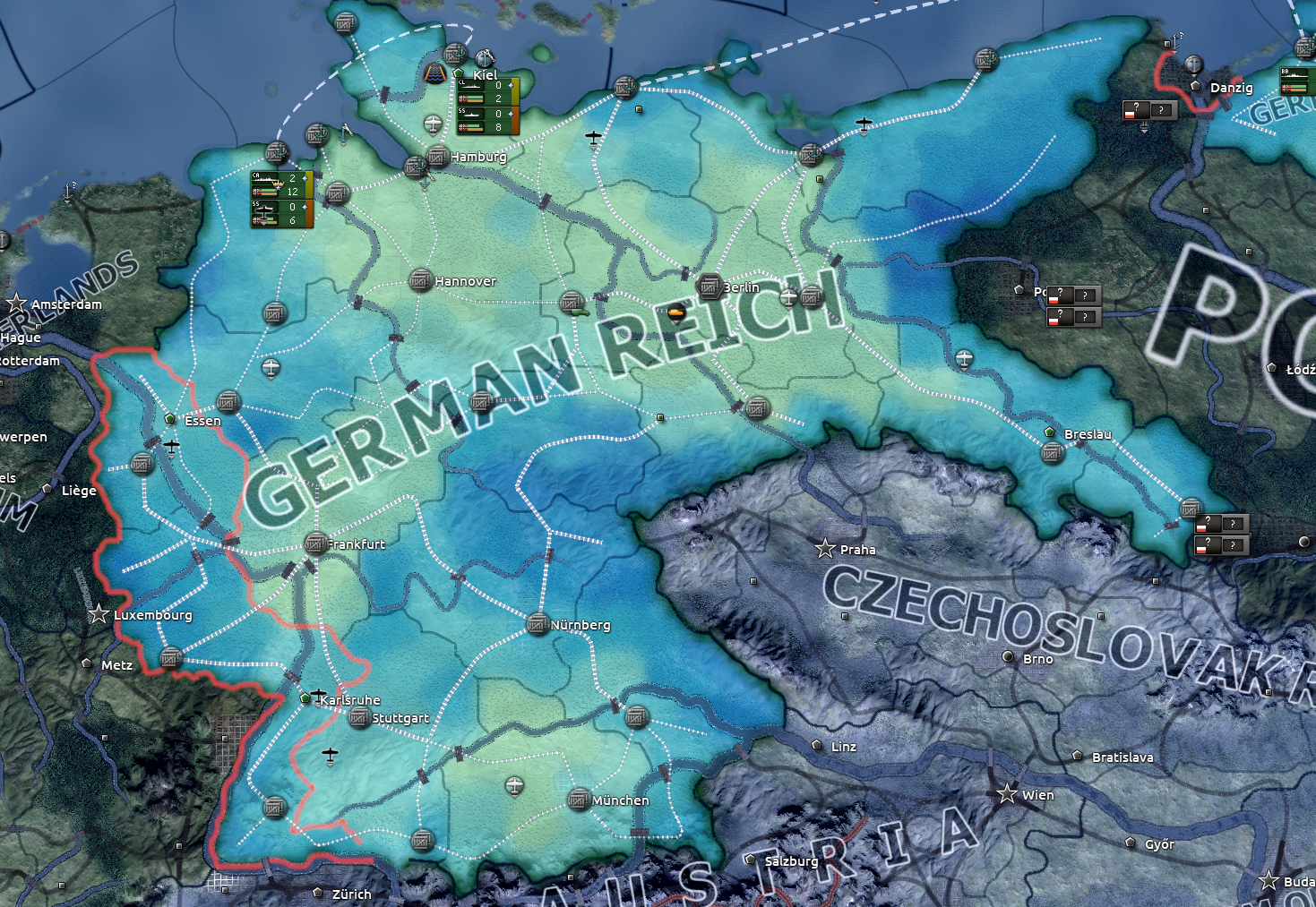
Supply depends on three means of transport: trains, trucks, and convoys, each covering the stretch of the route the other two can't reach. Trains move the bulk of the volume: supply travels from your capital and production centers to the front along railways, and each rail level has a fixed throughput: 15 supply at level 1, 20 at level 2, 25 at level 3, 30 at level 4, and 35 at level 5. The weakest link in the whole route — the rail segment or port with the lowest throughput — is what caps everything reaching the front, so upgrading one stretch does nothing if the real bottleneck sits further back. In territory with poor infrastructure — Siberia, inland China, much of Africa — upgrading the railway isn't enough on its own: engineers can build  supply hubs that extend the network's reach beyond the last usable rail line.
The Real Numbers on Shortage
Every division carries a buffer of up to 150% of the supply it needs, giving it roughly 2-3 days of full performance even in a poorly-supplied province — you don't feel the problem instantly, you feel it once that buffer runs dry. Below that point, the penalties are concrete and not symmetric: up to -20% attack but up to -50% defense, so an undersupplied division suffers far more holding a line than attacking with it. And if supply drops to 35% or less, you're in attrition territory: you start actually losing equipment, not just performance, without the enemy having to fire a shot.
 Trucks, Convoys, and Logistics Company
Where the railway doesn't reach, the game automatically assigns trucks to cover the gap, at the cost of steel and manpower. The motorized or mechanized logistics company, as a support unit in the division template, cuts that division's supply consumption and widens its margin before penalties start — worth it for divisions that will operate far from the rails, like the spearhead of an offensive.
 Convoys cover the third stretch: the one that goes by sea. Any territory without a land connection to your network — colonies, islands, a beachhead you've just opened — depends on them to receive supply. They compete for the same convoy capacity you use for trade or bringing in reinforcements, and they're just as vulnerable to enemy submarines and aircraft as any other merchant convoy, so an unescorted sea route is as real a weak point as a severed rail line.
When You're About to Run Out of Supply
Supply problems almost always show up at the same three moments: an offensive advancing faster than your rail network can keep up, an amphibious landing far from the nearest supply hub, or a pocket the enemy has deliberately cut off. If you're about to attempt any of the three, build supply hubs ahead of time or plan for your spearhead divisions to arrive weaker than you'd expect — and if they're going to sit on defense once they've taken the ground, remember that -50% defense penalty hits far harder than the -20% attack penalty you'd already priced in.
When there's no time left for any of that, there's a last resort: the  air supply mission, which uses transport planes to parachute equipment straight into a cut-off pocket. It burns fuel and exposes those planes to enemy fighters if you don't have air superiority over the area, and it never covers as much as a normal land route — but it can be the difference between breaking the encirclement in time and losing the division outright.