
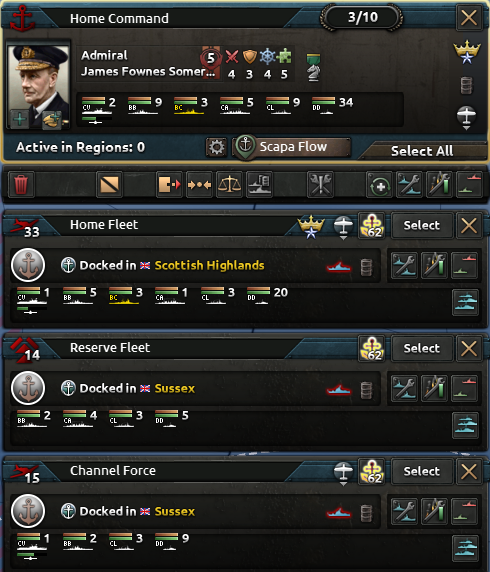
If you're playing a continental power, naval warfare takes care of itself. But for the UK, Japan, or the United States, it carries as much weight as the land front. The fact that changes how you should plan your whole fleet: escort efficiency depends on how many ships you have, not how good they are — a cheap destroyer protects a convoy exactly as well as an expensive one.
Every Available Mission
Each task force can only hold one active mission at a time, and the game lists them in this order, left to right, in the assignment panel:

 Patrol: actively searches for enemy ships in the assigned region; once they're 100% spotted, the task force can engage.
 Strike Force: automatically intercepts and attacks enemy forces already spotted by one of your own patrols in the same area; while there's nothing to intercept, it stays in port to save fuel.
 Convoy Escort: protects your own and allied convoys if attacked, across every region assigned to the fleet.
 Naval Exercises: trains the crew, gaining experience up to "Regular" level, at the cost of fuel and a bit of accident risk.
 Convoy Raiding: hunts enemy convoys in the area to sink them; each raiding force only efficiently covers 1.5 strategic regions.
 Naval Minelaying: lays naval mines in the assigned region until it's saturated (1,000 mines).
 Naval Minesweeping: with minesweeping gear, clears enemy naval mines from the assigned region.
 Naval Invasion Support: escorts convoys carrying your own troops during an amphibious invasion, then holds position to support with shore bombardment for as long as the battle lasts once they've landed.
 Hold: if there's an adjacent land battle involving enemy divisions, ships under this order automatically shell the coast to cut the enemy's attack and defense.
Fleet Composition: The Exact Ratio
A fleet splits the work into two roles: capital ships ( battleships,
  carriers) that bring the real firepower, and screens (
 destroyers,
  cruisers) that protect them from torpedoes. The concrete figure: you need a minimum of 3 screen ships per capital ship to reach 100% torpedo-protection efficiency — and it's worth bringing a few extra, since that efficiency drops if positioning is poor in battle or you lose some screens along the way.
If you have enough of a fleet, it also pays to split it into more than one strike force per fleet, so you can intercept more than one enemy force at once instead of letting one slip away while you're responding to another.
 Convoys: Why Quantity Beats Quality
Convoys move traded resources and troops by sea, and losing them to submarine or air attacks cuts that supply off cold. Here's the fact that actually changes how you build your escort fleet: both escort efficiency and torpedo screening efficiency depend purely on the number of ships assigned, not their quality — the cheapest, weakest destroyer you can design contributes exactly as much efficiency as a battleship. On top of that, the AI uses an "engage at medium risk" rule for its convoy-raiding submarines, which flee the moment defending destroyers show up, regardless of how strong those destroyers actually are.
The practical takeaway: for convoy protection, a cheap destroyer (early hull, level-1 battery and engine, no sonar or depth charges) mass-produced is just as effective as an expensive fleet, because enemy submarines flee either way and efficiency is measured by hull count. Save the spending on expensive gear and sonar for your combat fleet, not your convoy escort.
 The Submarine Threat and Minelaying
A submarine is cheap to build next to a surface fleet, and can do disproportionate damage to convoys and poorly-screened enemy fleets. With little naval industry, the move isn't competing ship for ship — it's using submarines to deny the sea to a much bigger rival. Detecting a submarine during battle is difficult even with sonar, and depth charges are useless against one that hasn't been detected.
 A lesser-known but very profitable use: the AI barely pays attention to minefields and only does minimal minesweeping on its own, so aggressively mining naval routes is a cheap way to gain naval superiority against the AI. Submarines are ideal for this job — equipped with mine-laying tubes and a "never engage" order, they can lay mines almost risk-free (they're only vulnerable to naval bombers, which the AI rarely uses enough against them).
How a Fleet Gets Lost
Sending the main fleet out on patrol below the 3-screens-per-capital-ship ratio and losing very expensive ships to a handful of submarines is the classic one. The second mistake is spending on expensive, well-equipped destroyers for convoy escort, when that efficiency depends on hull count, not quality — that budget pays off far more in your combat fleet.