
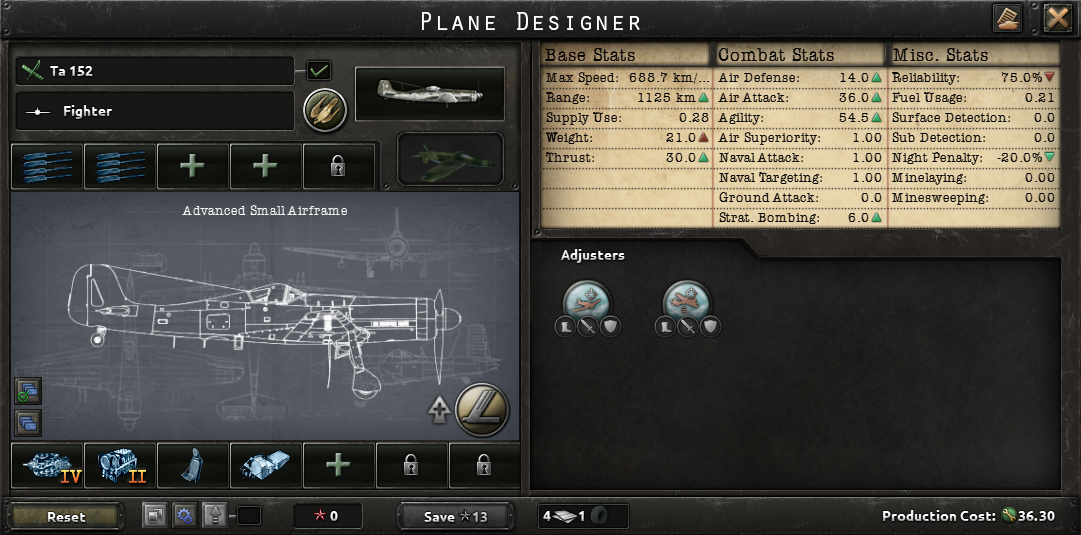
By Blood Alone (2022) did to aircraft what No Step Back had already done to tanks: the fixed fighter, tactical bomber, and strategic bomber models disappeared, and instead you build each plane piece by piece — airframe, engine, main armament, and auxiliary modules — letting the game calculate the final stats and production cost on its own. Without this expansion active, the game still uses the old fixed-model system — everything below only applies if you have it.
 Airframe: Small, Medium, or Large
The airframe is the base of the design, and its size decides which roles the plane can fill depending on the weapon you mount in the first armament slot:
 Small — the most agile and cheapest; a fighter gun makes it an interceptor/fighter, a bomb makes it close air support, and a torpedo or naval bomb makes it a naval bomber. Its carrier variant can operate from ships.
- Medium — more armor and range at the cost of agility; becomes a heavy fighter, tactical bomber, or scout plane depending on the main weapon.
 Large — built to go far and take hits, not to dodge; becomes a strategic bomber or a naval patrol bomber.
Just like tanks, each size has generations unlocked through research (Basic → Improved → Advanced → Modern), and each generation raises agility, air defense, speed, and base range. Switching airframe families mid-game forces you to redo the whole design, since the parts aren't interchangeable across sizes.
 Engine: How Many and What Level
The engine is required and drives a big part of the base stats: thrust, top speed, and agility, at the cost of weight and fuel consumption. Larger airframes allow mounting more than one engine at a time — two engines give more total thrust, but also more weight and cost — and within each airframe you can pick whichever engine level (I, II, III...) you've researched, each one giving more thrust than the last. Upgrading the engine level is usually the cheapest way, in air experience, to redesign an existing plane, compared to switching airframes entirely.
 Main Armament: Decides the Role
The weapon you place in the leftmost armament slot doesn't just provide most of the damage: it defines what kind of plane the design actually is. Machine guns and small cannons make a fighter; bombs make close air support or a bomber depending on the airframe; torpedoes and naval bombs make a naval bomber or patrol plane; recon cameras make a scout plane. Changing only that weapon — without touching anything else in the design — can turn a fighter into a completely different ground-attack plane in practice.
 Auxiliary Modules
Beyond the main weapon, every airframe has free slots for extra modules: armor plates (add air defense at the cost of range and weight), extra fuel tanks (range at the cost of air defense and weight), radios and electronics (radar, targeting upgrades), and on naval designs, defensive turrets or gear specific to operating over water. Just like with tanks, there's no universal combination — it depends on what role you're giving the plane and which slots are left after covering the essentials.
Regulators: What Your Industrial Organizations Bring
If you have Arms Against Tyranny active, you'll see a "Regulators" section under the stats: these are the bonuses your assigned aircraft Military Industrial Organizations (MIOs) contribute to the design, based on whichever traits they've unlocked. This isn't a mechanic of the aircraft designer itself, just how the work of your organizations shows up there — to understand where those specific bonuses come from, look at each organization's trait tree, not the designer.
How to Read the Final Stats
The panel on the right groups the stats into three blocks. Base stats covers max speed, operational range, supply use, weight, and thrust. Combat stats covers what actually decides an air battle: air defense, air attack, agility, air superiority, naval attack, naval targeting, land attack, and strategic bombing. Misc stats covers reliability, fuel consumption, surface and submarine detection, night penalty, mine laying, and minesweeping. Production cost, at the bottom, climbs with every upgrade you add — a brilliant design on paper is worthless if your industry can't turn it out in the numbers you need.
Common Mistakes
- Prioritizing agility and speed without checking range — a fighter that's brilliant in combat but can't reach the front, or has to keep flying back to refuel, loses much of its real value.
- Mounting armor plates or extra tanks without thinking about the plane's role — an interceptor built for air superiority rarely needs a bomber's range, and loading it with weight just costs it agility.
- Redesigning only the armament and forgetting the airframe already fixes the available role — if you want to go from fighter to heavy bomber, sometimes the real fix is moving up an airframe size, not just swapping the weapon.
- Not checking production cost before replacing the model in production — just like with tanks, a design that's better on paper can slow down your replacement rate if it sends the cost per unit soaring.