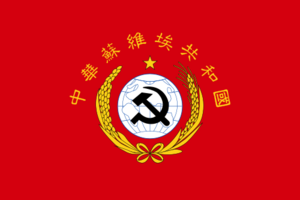
Of the three factions splitting China, the communist one is by far the weakest: a single civilian factory, a single military factory, not one dockyard. The  Chinese Red Army spirit sums up why: they've just finished the Long March, they're exhausted, and they have enemies on both sides —
  Japan on one flank, the Nationalists on the other. This isn't about winning fast, it's about staying standing.
Historical Context
 The Chinese Communist Party was founded in 1921, and after its alliance with the Kuomintang broke apart in a bloody purge in 1927, it was cornered by the Nationalists' encirclement campaigns until it set out in 1934 on the Long March, a retreat that reduced its forces from roughly 86,000 fighters to barely 8,000-9,000 survivors. The game starts in 1936 with Mao Zedong already consolidated in the party leadership after the Zunyi Conference, and with the newly-established base at Yan'an still reorganizing.
What Changed with No Compromise, No Surrender
Communist China's focus tree got its own dedicated expansion with No Compromise, No Surrender (2023), the same DLC that rewrote Nationalist China's tree and added the guerrilla warfare and insurgency system. Without this DLC, Communist China only has the more limited base-tree options, with far fewer political and military routes than the ones described in this guide.
National Spirits at Start
Communist China starts with four national spirits, and all four describe the same reality from different angles: an almost nonexistent economy, political legitimacy still to be consolidated, and an army that needs time to recover.

Defunct State Bank
+25% to consumer goods factory factor, −10% stability — they couldn't carry the currency printing presses through the March.

The Central Committee
+50% to justify war goal time — the party leadership, still reorganizing, slows down foreign policy decisions.
The Chinese Red Army
−15% army experience gain, −10% division organization, −10% recruitable population, −10% division attack, +10% training time — offset only slightly by −5% attrition and −5% required max planning.

Agrarian Society
−10% construction speed, −15% research speed, −10% factory output — a rural country with barely any industrial development or education.
Exhausted by the Long March
The Chinese Red Army spirit is the direct mechanical explanation for why this faction starts so weak militarily: the organization, attack, and experience-gain penalties reflect an army that has literally just finished a retreat of thousands of kilometers. Combined with only two factories total, any attempt to match Japan or the Nationalists on a conventional front is doomed — guerrilla warfare and terrain, not industry, are this faction's real asset.
The Focus Tree Branches
Communist China's tree is organized around several main blocks:
 Internal Stabilization — ends the Sufan repression campaign and consolidates political power and stability at the new Yan'an base.
 Burn the Paper Tigers — the historical branch: builds the United Front with the Nationalists against Japan and unlocks internal power-struggle decisions.
 The Leadership of Mao Zedong and
  Reclaim the Grasp of Power — the party's internal leadership dispute, between Mao's route and the Moscow-aligned 28½ Bolsheviks' route.
 Towards One China — the expansion and reunification branch, allowing you to form the People's Republic of China.
 Rally the Industry — agricultural and industrial development to offset the weak starting economy.
 People's Liberation Army (Ground, Air, Navy) and
  Central Military Commission — military specialization and modernization by branch, finally centralizing command of the armed forces.
This guide doesn't go into the detail of the more extreme political routes toward the end of the tree (the various possible outcomes of the civil war) — they're playthrough paths that will be covered in separate content later.
Mao or the 28½ Bolsheviks
The most important internal leadership decision pits The Leadership of Mao Zedong — the historical route, centered on guerrilla warfare and peasant mobilization, which in fact led the CCP to victory in 1949 — against Reclaim the Grasp of Power, the route of the so-called 28½ Bolsheviks, the Moscow-trained leadership group that controlled the party before Zunyi and favored closer alignment with  the Soviet Union and a more conventional military doctrine.
For a first playthrough, Mao's route is the more recommended one: it fits better with the weak starting industry and Chinese terrain, betting on irregular warfare instead of the conventional army this faction can't afford to build. For the few conventional divisions you do end up fielding, for the land doctrine tree we recommend  Superior Firepower: it doesn't need the armor industry you don't have, and its artillery and entrenchment fit a faction that survives by holding ground, not breaking fronts.
War Campaigns
If you're going to follow the historical script, what really matters isn't the exact dates but what you need to have ready at each stage to survive on two fronts. Here's what to do at each stage:
- Xi'an Incident — use this moment to lock in the truce with the Nationalists and gain international legitimacy, but don't treat it as a permanent alliance: it's political cover to expand with more room, not a lasting pact.
- Second United Front — use nominal nationalist command as cover while you focus your real effort on irregular warfare and base expansion; don't waste your two factories trying to look like a serious conventional army.
- Guerrilla warfare and base expansion — prioritize territorial consolidation and popular support focuses during this window of quiet expansion; it's your lowest-risk growth phase, and taking ground you can't hold afterward is pointless.
- Hundred Regiments-style offensive — don't launch a conventional offensive at this scale until you've built up real strength; a defeat here draws Japanese reprisals that can hurt the movement more than the offensive itself helps.
- New Fourth Army-style incident — don't assume the United Front is permanent: keep your forces ready to defend against a nationalist betrayal instead of blindly trusting the truce.
- Resumption of the civil war — by the time Japan falls, you should already have decided between Mao's route and the 28½ Bolsheviks' and have your People's Liberation Army developed; don't reach this phase having to improvise an army from scratch.
For the exact breakdown of combat widths and template composition, the combat width guide goes into the detail this guide only sketches out. See also the Nationalist China guide to see the same conflict from the other side.
Common Mistakes
- Breaking cooperation with the Nationalists too soon, before you have real strength to stand alone against Japan.
- Not deciding in time between Mao's route and the 28½ Bolsheviks' route, and ending up stuck halfway between both approaches.
Communist China's Achievements
Seven achievements, several shared with other Chinese nations and a few outright absurd:

Made in China
As Communist China, have over 100 military factories.

Sun Tzu Reborn
As any Chinese nation, have a level 9 field marshal.

The People Have Stood Up!
With Mao as your leader, win the Chinese Civil War.

Battle Royale
As Communist China, fight both China and Japan before 1940 within 90 days.

The Winner takes it all
As the PRC, own and control all starting Chinese core states.

Master Infiltrator
As the PRC, don't expand beyond Yan'an, and infiltrate at least 5 Chinese states.

Genghis Khan't
As any Chinese country or Manchukuo, own and control all Mongolian core states.