
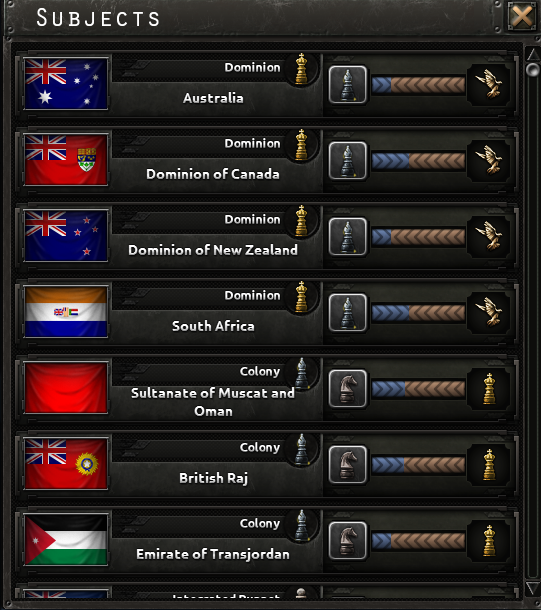
When you conquer or liberate a country you don't have to annex it outright: you can turn it into your puppet, installing a friendly government instead of absorbing its territory. It generates a lot less world tension than a bare-knuckle annexation, so it's usually the safer option if you don't want to risk foreign intervention — but how much real control you have over it depends on its autonomy level, and that's where most people get lost.
What a puppet is and why use one instead of annexing
A puppet is a country with its own "paper" government — loyal to your ideology — but whose foreign policy depends entirely on you: it can't declare or justify war on its own, and at the peace conference it makes no demands of its own unless its autonomy level allows it. In exchange, you can call it into your wars, trade with it at bargain prices and, at the lowest levels, keep a share of its industry. If the country you conquered has little territory or few resources, outright annexation almost always pays off more; puppeting makes sense with larger countries, where the world-tension discount and the manpower split are worth more than absorbing it whole in one go.
Autonomy levels: from Integrated Puppet to Dominion
The generic system (the one most democracies and communists use) has four rungs, from least to most independent. Each has its own autonomy bar from 0 to 1,000: at 1,000 you can raise it a level for 50  political power; at 0 you can lower it a level, or if it's already an Integrated Puppet, annex it outright for 300 PP.
 Integrated Puppet — the most subordinate: it hands you 75% of its military factories and 25% of its civilian ones, and you can recruit its divisions using 100% of your own manpower.
 Puppet — no longer shares industry with you, but the trade discount is still huge (90%) and its manpower counts at 90% for you.
 Colony — 50% trade discount, 70% manpower, and it starts sharing part of its peace score with you.
 Dominion — the most autonomous: only a 25% trade discount, but it can already make its own demands at the peace conference. Granting it full
  independence costs another 300 PP.
Fascist nations use a three-level variant instead —  Satellite, Reichsprotectorate and Reichskommissariat — with a bar that goes up to 1,500 instead of 1,000, and an important catch: all autonomy gain is reduced by 30%, so a fascist puppet has a much harder time earning independence than one under the generic system.
  Japan and Manchukuo also have their own three-level system with its own rules, but it's specific enough to those two nations that it's not worth memorizing unless you're playing them.
 The end state: if you never raise its autonomy, a puppet at the lowest level eventually drifts down to 0 on its own, at which point you can annex it outright (300 PP) without having to manage it any further. It's the fast lane for keeping a small country without ever dealing with its paper government.
Advantages and drawbacks of having puppets
Beyond the factory split and trade discount already mentioned, a puppet can receive Lend-Lease from you even in peacetime, and you can request its divisions on loan — usually poorly designed, so it's worth sending your own templates and equipment before using them for anything serious. You can also research different technologies than it does and share them afterward through licensing, which speeds up research on both sides. The main downside is that a freshly released puppet starts out with its master's division templates, not its own, so if you plan to use it in combat soon, prepare its designs beforehand; and if the conquered country has few resources, the trade discount doesn't make up for the factories you still have to pay for.
How to raise or lower autonomy
If you want to keep a puppet long-term with more autonomy (and its backing at the peace conference), you need to actively raise its autonomy: having it send you equipment, fight alongside you, or complete a dedicated continuous focus are the most reliable ways. If instead you want to lower it — to eventually annex it or keep more of its industry — building on its territory or sending it your own Lend-Lease pushes the needle toward your control.
Common mistakes
- Annexing a large country outright when a puppet would have given you almost everything good (factories, manpower, resources) for a fraction of the world tension.
- Puppeting a tiny country — with fewer than 8 units of a resource, you still pay full upkeep on its factories for a trade discount you barely notice; annexing outright usually pays off better there.
- Sending a freshly released puppet's divisions into combat without checking its templates first — they inherit yours, not its own, and may not match what that country actually has available.
- Letting autonomy rise on its own when you actually want to annex soon — building on its territory or sending it your own equipment keeps it low.