
Trade covers your shortfalls as long as peace holds and your routes stay open. Self-sufficiency is the other side of the coin: the less you depend on the outside world, the less a blockade or a war that suddenly cuts your routes can hurt you. But it has a very concrete construction cost worth knowing before you commit.
Why It Matters
A nation that depends on trade for its steel or oil is vulnerable: all it takes is an enemy cutting that convoy route, or you going to war with your supplier, for your industry to start failing at the worst possible moment. The closer you get to producing at home what you need, the less room you leave the enemy to strangle you without firing a single shot.
 Synthetic Refineries: The Real Cost
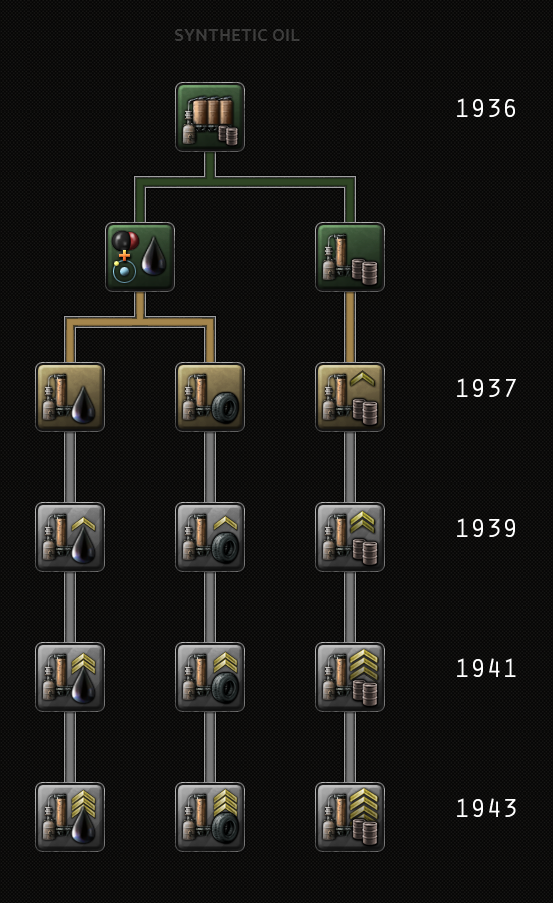
A synthetic refinery costs 14,500 base construction cost — more than a military factory (7,200), a dockyard (6,400), or even a civilian factory (10,800) — and can go up to level 3. In exchange, it produces between 48 and 168 fuel and between 1 and 5 rubber per level, depending on which synthetic oil technologies you've researched: better tech pushes you toward the high end of that range. They're not free, and synthetic oil in particular carries its own upkeep costs, but for a nation with no natural access to those resources, they're the difference between depending entirely on the outside world and having a cushion of your own.
 Resource Extraction
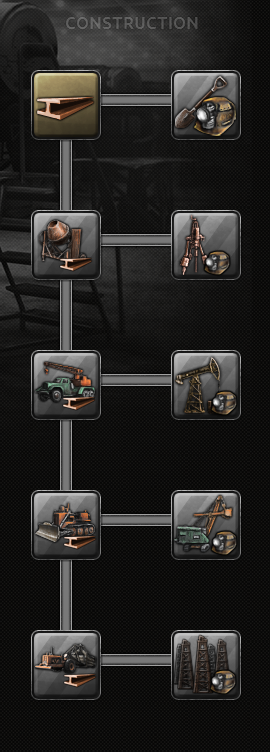
Resource extraction tech boosts the output of deposits you already hold, with no need to conquer another inch of map. It's one of the more cost-effective medium-term investments when your problem isn't "I have none of this resource" but "I have a little and it's not enough." This branch is paired with construction: every construction upgrade unlocks a matching extraction or refining upgrade in the same row.
When It's Not Worth It
Pouring industrial capacity into synthetic refineries or extraction has a real opportunity cost: that same 14,500 construction cost, spent on a military factory (7,200) instead, gets you almost double the direct production capacity. With stable trade access and no war on the horizon, it's sometimes simply better to buy the resource you're missing — especially taking advantage of the discount rate if you're trading with your own puppets — and point your industry elsewhere. Self-sufficiency pays off more the closer you are to a long war or to being cut off entirely.