
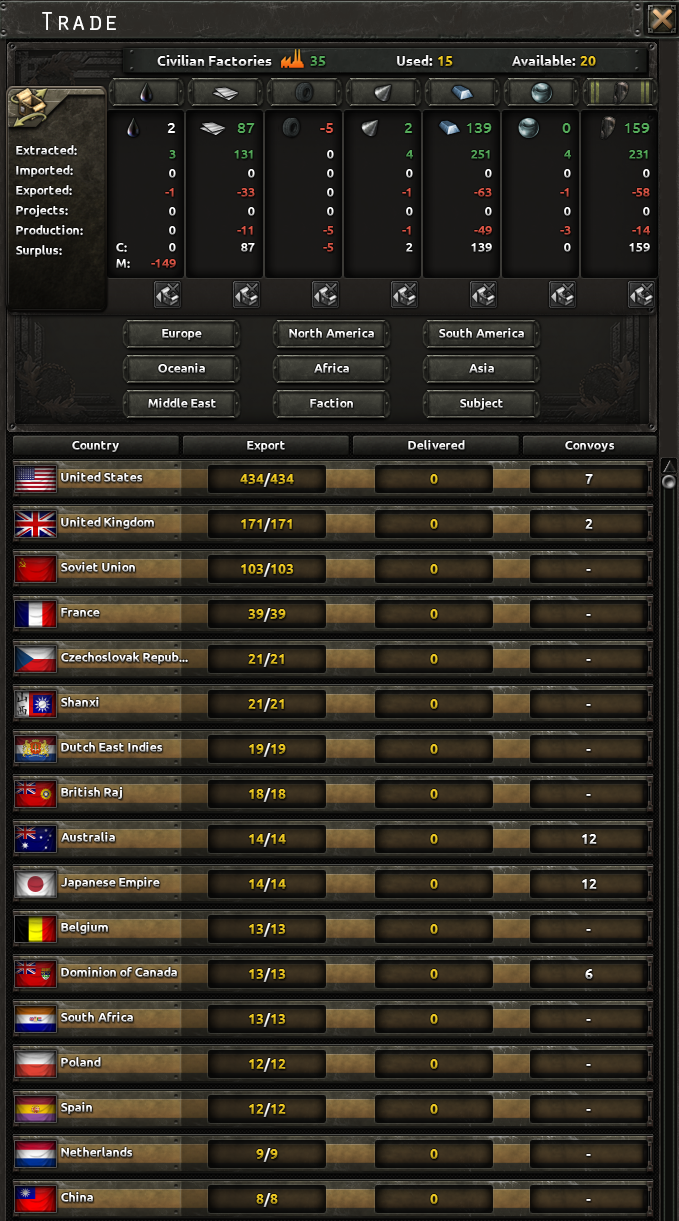
Almost no nation has all seven strategic resources at home. Trade covers those gaps without invading anyone — at least until invading them starts to pay off. The conversion rate is fixed and very concrete: 1 civilian factory buys up to 8 units of a resource... unless the seller is your own puppet, where that rate can multiply by ten.
 The Real Rate: 1 Civilian Factory Per 8 Units
Every civilian factory you dedicate to a trade deal buys up to 8 units of a resource available on the market — you need to spend at least 1 full civilian factory to strike any deal, even if the seller has less than 8 units free. The civilian factories you spend importing get added temporarily to the selling country's own factories for as long as the deal lasts: that country can use them to build, to satisfy focus requirements, or even to buy resources from a third party.
No prior diplomatic agreement is needed to trade: you just need 0 or more trade influence with the country, trade access, and them having a surplus available. The exporter doesn't even need to approve the deal.
Why Trading With Your Own Puppets Is Cheaper
Here's the lever almost nobody uses to its full extent: trading with your own puppet states breaks the normal 8-units-per-factory rate. A directly subordinate collaboration government or Reichskommissariat sells to you at 80 units per civilian factory — ten times the normal rate — while more independent dominions and satellite states offer between 10 and 16 units per factory. Some national focuses unlock laws or spirits that improve this rate even further, like Increased Trade for Germany or Port of Antwerp for Belgium.
The Trade Laws That Shape Everything
Your own trade law decides what percentage of your own resource extraction gets set aside for export to the market, whether it's actually sold or not:  Free Trade reserves 80%,
  Export Focus 50%,
  Limited Exports 25%, and
  Closed Economy 0%. The freer the law, the bigger the factory output, construction speed, and research bonuses attached to it — but also the less of your own resources you keep at home if you don't have enough surplus.
When Supply Gets Cut Off
Trade gets cut off if you go to war with whoever's selling to you, if an embargo lands on you, or if the enemy cuts your convoy or overland transit routes — without a valid transport route, the deal stops delivering resources even though you're still paying the civilian factories for it. Leaning too hard on a single supplier for a critical resource is a risk: cut that route mid-war and your production suffers right when you need it most.
The Cost of Ignoring It
Ignoring the trade screen the whole game and letting your factories underperform for resources you could've bought with no effort is the usual mistake. The second is not taking advantage of the discount rate when trading with your own puppets, paying the normal 8-units-per-factory rate when you could be buying at 80. The third is relying on trade with a country you already know you're going to attack later — plan alternatives before you cut the tap yourself.