
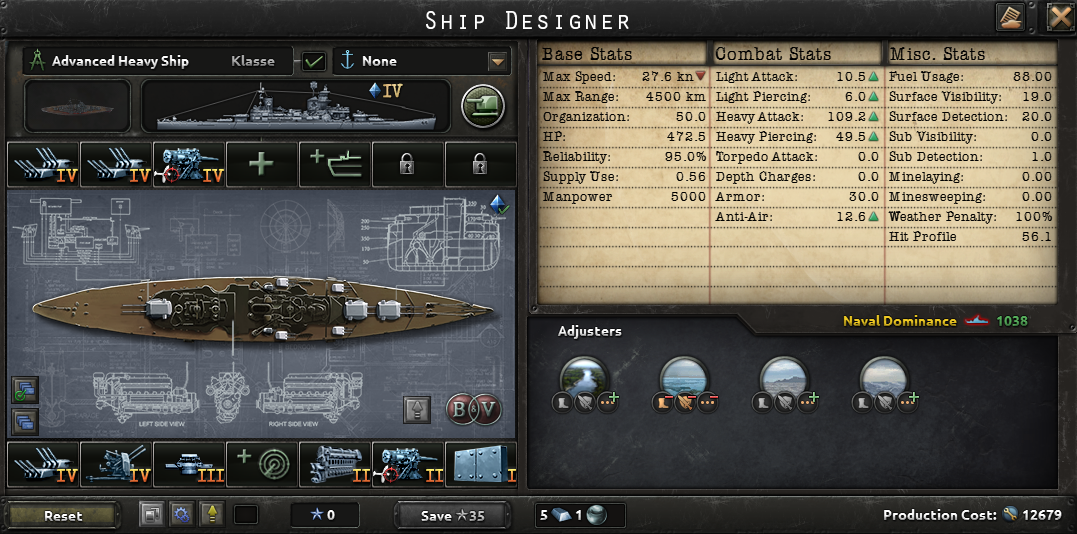
Man the Guns (2019) replaced the old fixed naval models with the same modular system that later reached tanks and aircraft: you pick a hull and fit it out with engine, main armament, and auxiliary modules, letting the game calculate the final stats and production cost on its own. Without this expansion active, the game still uses the old fixed-model system — everything below only applies if you have it.
Hull: Where It All Starts
The hull is the base of the design, and unlike tanks and aircraft, there's no flexible template here that switches roles depending on the weapon you mount: each family is practically its own design track, with its own slots and its own place in the fleet:
 Destroyer — the fastest and cheapest, with very little armor and few slots; the backbone of the fleet's anti-submarine and anti-air escort.
 Cruiser — the balance between speed, range, and firepower; can stay in light guns against other cruisers and destroyers or carry near-battleship pieces.
 Battleship — the line-of-battle ship proper, with the heaviest armor and guns in the game, at the cost of speed and a sky-high production cost.
 Carrier — trades away almost all its own guns for hangars; its real firepower comes from the squadrons it carries, not its own cannons.
 Submarine — its own designer, with its own tab and far fewer slots; built to strike with torpedoes from underwater and go unnoticed rather than to take hits.
Each family has several generations unlocked through research (Early → 1936 → 1940 → 1944), and each generation raises speed, hull points, and base reliability, on top of opening up more module slots. Switching hull families mid-game forces you to redesign the ship from scratch, since the parts aren't interchangeable across families.
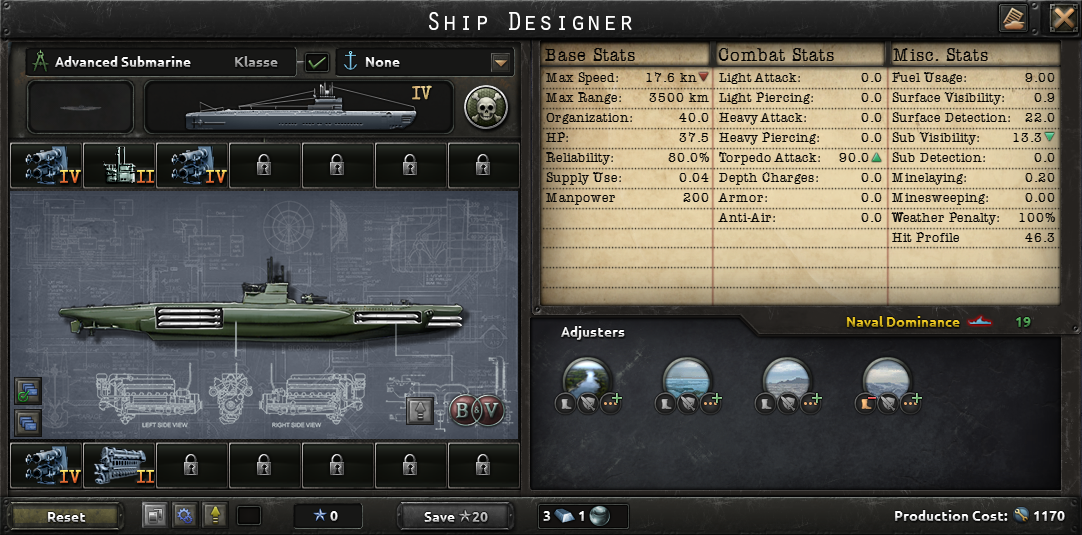
The submarine uses a design screen very similar to every other hull's, but with considerably fewer slots available and no real armor to configure: its defense is not being detected, not soaking up hits.
 Engine: Speed and Range
The engine sets the hull's top speed and fuel consumption, and within each family you can pick whichever engine level (I, II, III...) you've researched, each one more powerful than the last at the cost of more weight and consumption. Upgrading the engine level is the cheapest way, in research time, to redesign an existing ship without switching to a whole new hull.
 Armor: Belt and Deck
Armor combines belt (side) armor and deck armor into a single module, available on cruisers, battleships, and carriers — destroyers and submarines don't carry it, so as not to lose speed: more armor adds hull points and reduces the damage taken from torpedoes, but also cuts top speed and raises supply use. Each hull family has its own armor progression unlocked through research (Cruiser Armor I through IV, for instance, or the "All-or-Nothing" scheme reserved for the most advanced battleships), and you can't use another family's armor or skip a level.
 Main Armament: Guns and Torpedoes
Every hull reserves a fixed number of slots for main armament, and what's available depends on the family: light batteries are fast and accurate against small targets and aircraft, medium batteries give the damage jump meant for destroyers and cruisers, and heavy batteries are almost exclusively battleship and large-cruiser territory. Torpedoes — as deck-mounted launchers or a full torpedo room on submarines — don't rely on the gunnery crew's aim and are the only way to damage a ship below the waterline. The armament combination you pick, together with the hull, is what actually defines the design's role in the fleet: a cruiser loaded with heavy guns edges toward a light battleship, while one loaded with torpedoes becomes a surface hunter.
 Auxiliary Modules
Beyond the armament, every hull has free slots for support modules: fire control systems (improve the accuracy of all onboard guns), radar and sonar (surface and submarine detection), depth charges and anti-submarine mortars (essential on escorts dedicated to hunting submarines), extra deck armor on carriers (protects the hangar from bombing at the cost of speed), and hangars and deck facilities that decide how many squadrons the ship can operate. There's no universal combination — it depends on the role you're giving the design within the fleet and which slots are left after covering the essentials.
Regulators: What Your Industrial Organizations Bring
If you have Arms Against Tyranny active, you'll see a "Regulators" section under the stats: these are the bonuses your assigned naval Military Industrial Organizations (MIOs) contribute to the design, based on whichever traits they've unlocked. This isn't a mechanic of the ship designer itself, just how the work of your organizations shows up there — to understand where those specific bonuses come from, look at each organization's trait tree, not the designer.
How to Read the Final Stats
The panel on the right groups the stats into three blocks. Base stats covers max speed, max range, organization, hull points (HP), reliability, supply use, and manpower. Combat stats covers what actually decides a naval battle: light attack, hull piercing, heavy attack, gun piercing, torpedo attack, depth charges, armor, and anti-air power. Misc stats covers fuel consumption, surface visibility and detection, submarine visibility and detection, and mine laying and minesweeping. Next to the stats you'll also see the design's Naval Dominance: the contribution that ship makes to controlling the sea zone it's stationed in, key to forcing or blocking amphibious invasions — a battleship contributes a huge amount, a submarine almost nothing, because its value is in stealth, not surface superiority. Production cost, at the bottom, climbs with every upgrade you add — a brilliant design on paper is worthless if your shipyards can't turn it out in the numbers you need.
Common Mistakes
- Loading a battleship with anti-submarine modules it will never use — sonar and depth charges are meant for dedicated escorts, not line-of-battle ships that rarely get close to a submarine.
- Designing a carrier without enough deck armor or anti-air power — its real firepower is in the air, but a direct hit sinks it just like any other ship.
- Forgetting sonar and depth charges on escort destroyers — without them, the destroyer can't fill its real role as a submarine hunter, no matter how well-armed it is against other surface ships.
- Not checking production cost before replacing the model in production — just like with tanks and aircraft, a design that's better on paper can slow down your replacement rate if it sends the cost per unit soaring.