
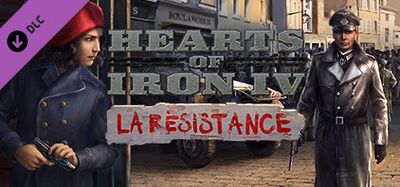
France starts with a large army and the  Maginot Line as its identity, but also with the historical stigma of a six-week collapse. This whole guide revolves around one idea: don't repeat that script — starting with understanding why French doctrine begins so outdated.
Historical Context
France won the First World War at a cost that marked an entire generation, and that memory is the root of the Maginot Line: the response of a country that doesn't want to bleed like that again. The game starts in 1936 with the Popular Front about to win the elections under Léon Blum, and the game captures that political instability on top of a defense industry weaker than the country's population size would suggest.
National Spirits at Start
France starts with seven national spirits that, together, explain why Western Europe's largest army performs well below its size on paper.

London Naval Treaty Signatory
Design cost caps: 9,500 for carriers, 5,300 for cruisers, 10,000 for capital ships.

Victors of the Great War
-0.3% recruitable population. -5% war support. +50% land doctrine cost.

Disjointed Government
+0.80 daily political power cost. -10% stability. -50% surrender limit.
Protected by the Maginot Line
-25% planning speed. +25% max planning.

Full Employment
-25% recruitable population factor.

Political Violence
Reflects the Third Republic's instability between the Popular Front and the National Bloc.

Inefficient Economy
-20% factory output. -20% dockyard output.
A Big Army with Old Doctrine
On paper, the French army is impressive. In practice, it carries the Victors of the Great War spirit, which makes any new land doctrine 50% more expensive — the exact mechanical reason France feels stuck in a 1918 mindset. The Maginot Line covers the border with  Germany well and gives a solid planning cushion, but leaves the Ardennes-Belgium flank as the weak point history already knows all too well.
The Focus Tree Branches
France's tree is organized around five main branches:
 Devalue the Franc — develops the metropole and overseas colonies, adds research slots.
 French Union — coordinates France's huge colonial empire, from North Africa to Indochina.
 Begin Rearmament — the main military branch, with two mutually exclusive sub-branches: reinforce the Maginot or modernize land doctrine (see below).
 Naval Rearmament — experience and research bonuses for the Navy.
 Air Focus — experience and research bonuses for the air force.
The political tree, with the Popular Front and the National Bloc as the two big blocs of 1936, can lead to much more extreme branches ( communist,
  fascist, monarchist) if you push it that way. This guide doesn't go into the detail of those alternate routes — they're playthrough paths that will be covered in separate content later.
Maginot or the Battle of Maneuver
Inside "Begin Rearmament" is the piece that really makes the difference: choosing between extending the Maginot Line or committing to the  Battle of Maneuver, the sub-branch that modernizes doctrine toward a war of movement with
  tanks and motorized units. You don't need to abandon the Maginot entirely, but you do need to build a reserve capable of plugging the Ardennes gap if Germany doesn't follow the historical script — it doesn't need to be huge, but it does need to move fast. It's the difference between containing a breach and watching it turn into a total collapse.
Doctrine and Division Templates
France doesn't start with any doctrine unlocked, and on top of that the Victors of the Great War spirit makes whichever one you pick 50% more expensive. That makes the early choice matter even more than for other nations: the sooner you commit to a war-of-maneuver doctrine or stick with a more defensive posture, the sooner that expensive investment starts paying off. If you commit to the Battle of Maneuver, the grand doctrine that actually makes the most of those tanks and motorized units is  Mobile Warfare — it's exactly what the real France needed in 1940 and didn't have. If instead you'd rather lean on the Maginot,
  Superior Firepower fits better with artillery and entrenchment.
For the exact breakdown of combat widths and template composition, the combat width guide and the doctrines guide go into the numerical detail this guide only sketches out.
War Campaigns
If you're going to follow the historical script, what really matters isn't the exact dates but what you need to have ready at each stage so you don't repeat the 1940 collapse. Here's what to do at each campaign:
- Declaration of war on Germany — as soon as it invades
 Poland, honor your guarantee alongside the
  United Kingdom without hesitating; the front stays calm for several more months, so declaring early costs you nothing.
 - The "Phoney War" — don't just sit behind the Maginot doing nothing: use these calm months to finally settle the choice between Maginot and Battle of Maneuver, and start building that mobile reserve now, because with doctrine 50% more expensive it takes longer to get ready than you think.
- German invasion through the Ardennes — this is the moment that decides the game: if you don't have a mobile reserve able to plug that gap in time, the front collapses exactly like it did historically, no matter how well-garrisoned the rest of the Maginot is.
- Front collapse and a Dunkirk-style evacuation — if the front gives way, evacuate whatever divisions you can save instead of letting them get encircled; those troops are what rebuilds the defense in the south or the colonies — encircled, they're worth nothing.
- Fall of Paris — decide in advance whether you'll declare the capital an open city or defend it; a doomed defense just wastes divisions you could save to keep resisting elsewhere.
- Armistice and division of the country — if you can't avoid the metropole collapsing, have a government-in-exile plan ready in advance, along with handing off the fleet and the colonies, so you don't lose everything at once.
- Free France — keep your colonial empire's industry and manpower organized under a resistance government so it isn't wasted even if the metropole falls.
- North Africa campaigns — hold the colonial garrison even if you lose the metropole; that territory is the real base to rebuild an army for the final counteroffensive.
- Dragoon-style counteroffensive and final advance — by the time this moment arrives, your Mobile Warfare doctrine and armor production should already be feeding a real offensive army coordinated with the Allies, not a last-minute token force.
Common Mistakes
- Not coordinating with the United Kingdom from the start — France's game depends heavily on that alliance to hold on.
- Neglecting internal stability — the Disjointed Government spirit already penalizes starting political power and stability; ignoring domestic politics only makes that worse.
This guide will expand with more detail on doctrine options and a comparison of defensive versus more aggressive routes; the diplomacy and factions guide explains how to get the most out of the alliance with the United Kingdom.
France's Achievements
Five achievements specific to France, from the most straightforward to the ones that require a whole game planned around them:

Vive la France
Reach 1948 as France without capitulating or surrendering.

Vive la Jeune Ecole
Have at least 150 destroyers and research the maximum torpedo launcher technology before 1945.

Big Entente
Complete the "Little Entente" focus and have all German cores owned by you or someone in your faction.

Die, Perfidious Albion!
As Fascist France or Vichy France, occupy all of the United Kingdom.

Second Time's the Charm
Occupy Moscow while Napoleon VI is your country leader.