If you've never opened Hearts of Iron IV and the rest of the guides on this site read like gibberish, start here. We're not going to dig deep into any mechanic — that's what the rest of the files are for — just give you enough to survive your first game without your head spinning.
What Hearts of Iron IV Is
It's a large-scale strategy game that kicks off in 1936 and runs through the late 1940s. You run an entire country: its internal politics, economy, army, diplomacy... and you can end up fighting World War II pretty much as it really happened, or veer completely off the historical script. It plays in real time, but you can pause whenever you want — and early on, you should, a lot.
Before Your First Game
- Pick a small, well-documented nation — don't jump straight into Germany or the USSR yet. In the nation list, filter by the
#basictag: you'll find options like Portugal,
  Canada or
  Finland, all with a complete guide on this site and a game with a clear beginning, middle and end.
 - Leave
 "Ironman" (the no-manual-save mode) for later. Being able to reload a save will spare you more than one rookie mistake.
 - Play at minimum speed at the start. You'll speed things up once you get the hang of it.
How to Read the Main Screen
Before touching anything, find these elements: they're always on screen and they're not going anywhere for the rest of the game.

 Political Power (PP): top left. It's the "currency" you spend to activate focuses and change national laws. It accumulates on its own, gradually.
 Stability and war support: two bars next to PP. They affect production, morale and how many people you can recruit. The lower they are, the worse everything goes.
 Manpower: the population available to form divisions. It's spent when you recruit and recovers very slowly.
- Time controls: top right — date, speed and pause. Keep a finger near the spacebar.
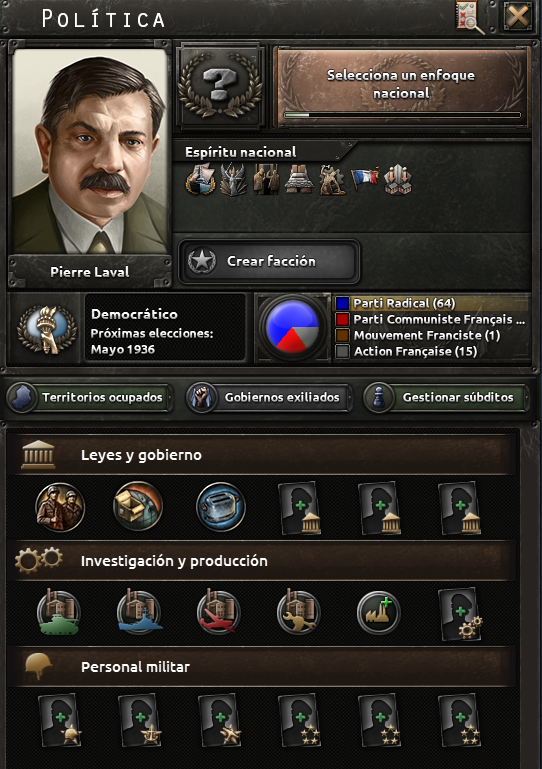
- Politics: the button with your country's flag. This is where you'll find the focus tree (one focus every few days), your national spirit, party support, and the active laws for government, research and military personnel.
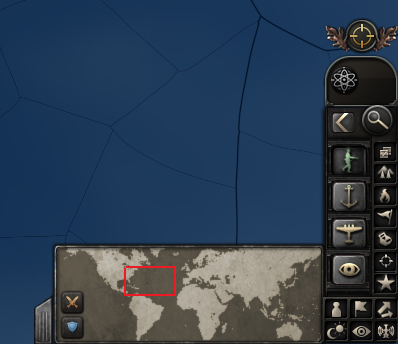
- The minimap: bottom right. Switches between political mode, supply mode, production mode, etc. — it tells you what information is shown on the main map.
Your First Game, Step by Step
- Pick your nation and enter the game. Don't touch everything at once: first take a calm look at the main screen.
 Open the focus tree (the button with your country's flag) and activate your first focus. If there's a guide for that nation on this site, follow its "recommended route."
 Check the production screen and
  set a couple of
  civilian factories or an infrastructure upgrade building, depending on what you can afford.
 Check the research screen and put something in the queue — an empty slot is time you don't get back.
- Let time pass slowly, pausing whenever an event pops up or a focus finishes, and start the cycle again.
The Game's Pillars, One Sentence Each
You don't need to master any of this on day one. Here's the one-sentence version of each mechanic, just so you know it exists and which file to check when you actually need it.
- Focus tree: your nation's political, military and economic decision path. Every country has its own — check the specific guide for the nation you're playing.
 Production: civilian factories build infrastructure and buildings; military factories build equipment. Everything else depends on this.
 Research: technologies that upgrade your equipment and unlock new things. Never leave a slot empty.
 Combat width: how much "room" your army takes up in a battle. Calculated wrong, your divisions fight at half strength without you knowing why.
 Combat doctrines: your army's overall long-term "style." You pick one once and it's costly to change, so there's no rush to decide in your first game.
 Military command: generals and field marshals leading your armies. Their traits and experience affect combat.
 Diplomacy and factions: alliances, guarantees and non-aggression pacts. Never go into a major war completely alone.
 Naval warfare: fleets, convoys and protecting your maritime trade. Matters much more if you play a coastal power.
 Air warfare: air superiority, close air support and bombing. Almost everything else in the air depends on controlling the sky first.
 Intelligence: espionage, counter-espionage and covert operations. A more advanced mechanic, not essential at the start.
 Trade: buying and selling resources with other countries. Useful as soon as you're short on a strategic resource.
 Self-sufficiency: relying as little as possible on outside resources. Interesting in the medium term, not the first problem you'll run into.
Typical New-Player Mistakes
- Leaving research idle. An empty slot is time you don't get back — there should always be something queued.
 Rushing military factories. Without enough civilian factories first, your economy never really takes off.
- Building divisions without checking combat width. A badly calculated template performs far worse than it promises on paper.
- Ignoring stability and war support until they're already in the gutter, when fixing them costs twice as much.
- Not pausing enough. Playing in real time without pausing constantly is the fastest way to lose the thread.
- Going to war completely alone, with no faction or guarantee behind you. Even small nations need allies.
Where to Go From Here
Once you're moving comfortably through the menus, these are the logical next stops:
- The glossary of terms, for when you run into an acronym or word you don't understand.
- The list of nations — filter by the
#basictag to find countries meant for starting out. - A second guided game with another nation from the
#basictag, to reinforce what you've learned before improvising entirely on your own.